




Proven Measures to Create High-Quality Concrete Structures in Cold Weather
It is no secret that temperature plays a primary role in the strength development and overall quality of concrete. Colder temperatures slow down and sometimes stop the exothermic reaction of cement hydration, the foundation of concrete technology. Sub-freezing temperatures can permanently damage poorly protected concrete. In a nutshell, the onset of cold weather adds layers of difficulty to the construction of high-quality concrete pavements and structures.
At the same time, the days are gone when construction crews in the northern tier of the country might be idle during the cold weather months. Demanding schedules, economic incentives, and a better understanding of managing work in low temperatures have all influenced the winter scheduling of building and paving projects.
Cold Weather Questions Answered: A Complete Guide from ACI
The American Concrete Institute (ACI) Committee 306 publishes two documents that present the best strategies for cold weather concreting:
- ACI publication 306R-16 serves as a comprehensive guide and reference for project stakeholders, summarizing current best practices for placing concrete in freezing or near-freezing temperatures. This document is widely available and free to ACI members.
- ACI's publication 306.1-90 is written in a specification format, designed for reference or inclusion in project specifications and other contract documents to define requirements for cold weather concreting.
In its Chapter 1 introduction, the ACI guide takes an interesting perspective by looking at cold weather concreting as an opportunity. They note that properly produced low-temperature concrete, placed in cold weather and adequately protected, has the potential to develop higher ultimate strength, greater durability, and an increased resistance to thermal cracking.
Project specifications may vary, but the testing lab is typically tasked with tracking the strength development and quality of concrete placed in cold weather conditions. Along with routine pre-placement inspections of formwork and reinforcing steel, the logging of ambient and material temperatures may be required, and documenting the extent and execution of cold weather curing practices could be as well. Even if not required by project specifications, it is good construction practice to observe and note factors that affect the quality and integrity of the concrete.
Planning & Preparation: Getting Everyone on the Same Page
Long before the onset of cold weather, all the stakeholders of a construction or paving project should clearly understand what happens when the temperatures drop. A preconstruction meeting establishes responsibilities, methods, and resources for protecting newly placed concrete under any conditions. Topics can be considered and resolved with no need to make decisions under pressure:
- Alternate concrete mix designs can be discussed for cold weather use, including permissible admixtures, heating of mix water and aggregates, and use of air-entraining agents.
- Trigger points for the implementation of temperature protection can be decided in advance.
- Methods for monitoring and reporting ambient and material temperatures can be resolved.
- Practices and equipment for the protection of strength samples during initial curing can be established.
If a preconstruction meeting is impractical, the contractor could submit a cold weather protection plan for review and comment by the stakeholders.
Measuring & Recording Temperatures
The chart in Chapter 5 of ACI 306R features specific recommendations for the concrete temperatures as mixed and as placed when cold weather practices are being followed:
As mixed temperature requirements are determined by ambient air temperature and the minimum exposed dimension of the section. When air temperatures are below 0°F (-18°C), the concrete temperature as mixed must be 70°F (21°C) or more. For a section greater than 72in (1,800mm), the minimum as mixed temperature is 55°F (13°C).
Placing and maintained temperature requirements are generally slightly lower and governed chiefly by minimum dimensions. In the example above, the minimum concrete temperature as placed would be 55°F (13°C) for the 12in section or 40°F (5°C) for the 72in section. The maximum concrete temperatures as placed should not exceed 20°F (11°C) higher than the recommended minimum.
There are a number of additional temperatures covered in the ACI guide that are worth noting:
- 40°F (4°C): The guide establishes a standard definition of cold weather as "…when the air temperature has fallen to, or is expected to fall below, 40°F (4°C) during the protection period. The protection period is defined as the amount of time recommended to prevent concrete from being adversely affected by exposure to cold weather during construction."
- 32°F (0°C): Ice, snow, and frost must not be present on surfaces that come in contact with fresh concrete. The surfaces of rebar, №18 and smaller, embedments less than 4in², and formwork may be less than 32°F at the time of placement.
- 30°F: Water within concrete pores may begin to freeze.
- 25°–27°F (-3.9° to -2.8°C): Enough pore water will freeze to stop hydration.
- <27°F (-3.9°C): Ice formation in pores may affect the strength and structural integrity of concrete. When mix water freezes in concrete with a compressive strength lower than about 500psi (3.4MPa), permanent damage will result from the mechanical expansion of the ice.
Concrete Maturity and Temperature Sensing Instruments
- 4-Channel Data Logging Thermometer, -328°–2,501°F (-200°–1,372°C)
- Traceable® Dual-Laser Infrared Thermometer, -76-1,022°F, -60-550°C
- FLIR® One Thermal Imaging Camera
Ambient, surface, and internal temperatures should be monitored during initial curing and throughout the protection period. The guide does not specify instruments or methods for measuring or monitoring temperatures, making it easy to select the best equipment for specific applications.
- Electronic thermometers with data recording functionality are the most versatile instrumentation for many monitoring applications. Some can use pre-placed probes for periodic connection to the instrument for manual readings, or the instrument itself may be placed for continuous datalogging. Expendable thermistors or thermocouples can be embedded in the concrete during placement.
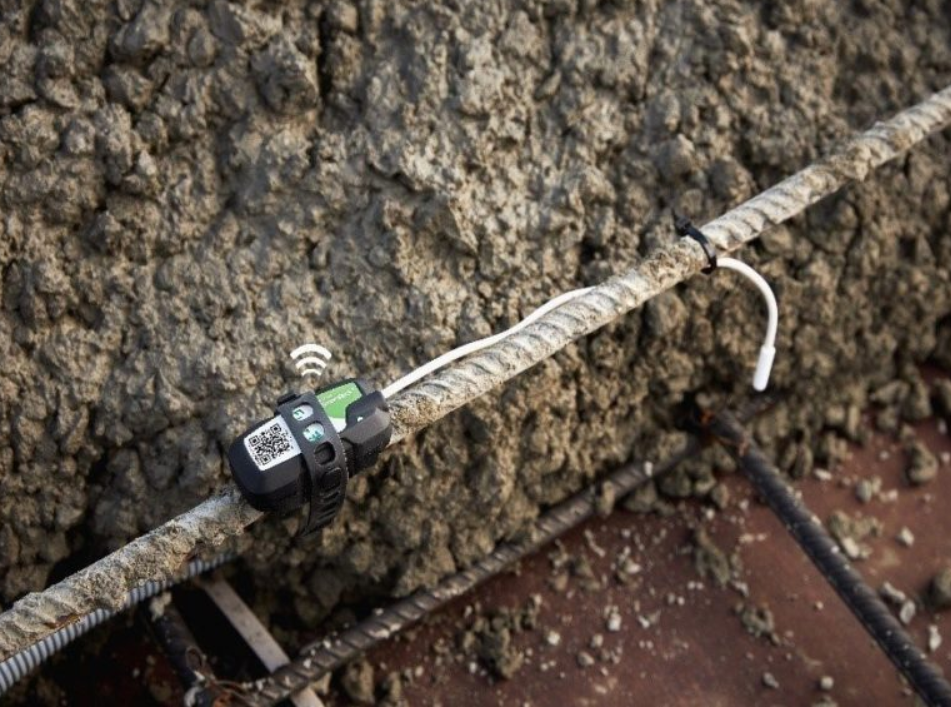
- Concrete maturity instruments are a good fit to record concrete temperatures over time. They have the obvious additional benefit of estimating the strength development of the concrete in real-time when used to determine concrete time and temperature factors as specified in ASTM C1074.
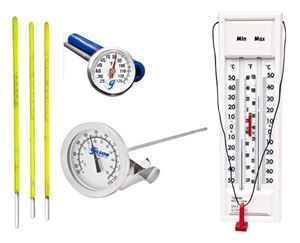
- Conventional analog or digital probe thermometers are ideal for measuring the temperature of fresh concrete during placement, following ASTM C1064.
During the protection period and after form removal, inspect the concrete surfaces for cracks or freeze damage, which could compromise structural integrity.
Customization & Placement of Concrete Mixtures
Mixes designed for cold weather placement may be enhanced with non-chloride accelerating admixtures or Type lll (high-early strength) cement to reduce set time and increase early age strength development. Air entrainment might also be used as a tool to increase resistance to early-age frost damage and increase long-term durability.
ACI Recommended Concrete Temperatures
| Minimum Dimension of Concrete Section | |||
<12in (300mm) | 12—36in (300—900mm) | 36—72in (900—1800mm) | >72in (1800mm) | |
Air Temperature | Minimum Concrete Temperature as Mixed1 | |||
>30°F (-1°C) | 60°F (16°C) | 55°F (13°C) | 50°F (10°C) | 45°F (7°C) |
0°— 30°F (-18°— -1°C) | 65°F (18°C) | 60°F (16°C) | 55°F (13°C) | 50°F (10°C) |
<0°F (-18°C) | 70°F (21°C) | 65°F (18°C) | 60°F (16°C) | 55°F (13°C) |
— | Minimum Concrete Temperature as Placed & Maintained | |||
55°F (13°C) | 50°F (10°C) | 45°F (7°C) | 40°F (5°C) | |
Maximum Concrete Temperature as Placed | ||||
75°F (24°C) | 70°F (21°C) | 65°F (18°C) | 60°F (16°C) | |
1Maximum temperatures for concrete as mixed are 15°F (9°C) higher than the indicated values.
Sampling & Testing Fresh Concrete
Generally, basic methods for testing fresh concrete don't change much in cold weather conditions. Extra care is needed to protect bulk samples from mixers or pumps during the execution of slump, air content, unit weight, and temperature tests. Check cylinder and beam molds for snow and ice before casting strength samples and ensure that the surfaces of testing equipment are not frozen. In extreme cold, plastic cylinder molds may break if tapping for consolidation is too aggressive.
Concrete mixes designed for cold weather might have unique characteristics, so thorough testing is essential. Air content and unit weight tests are significant predictors for later strength and durability performance. The Super Air Meter is especially useful in characterizing air void size and distribution, which are important predictors of durability and freeze-thaw resistance.
Protection & Curing for Test Specimens
As soon as the strength samples are molded, they should be moved to the initial curing location without delay. ASTM C94 requires the initial curing of strength samples for acceptance testing to comply with the standard curing methods noted in ASTM C31.
Temperatures for initial curing of concrete cylinders for acceptance testing must be 60° to 80°F (16° to 27°C) for design strengths less than 6,000psi (40MPa) and 68° to 78°F (20° to 26°C) for higher strengths. They must also be in an environment that controls the loss of moisture. Portable Concrete Curing Boxes are available with options for heating and cooling, heating only, or insulation that can be used on-site for the initial phase of standard curing. When retrieved for transport to the testing laboratory, strength samples must be protected from freezing as well as from jarring and shock.
Protection & Curing for Concrete Elements
The type and duration of early-age protection is influenced by many factors, such as available resources and cost, but is dictated primarily by weather conditions and the structural application of the concrete.
Concrete Cold Weather Protection Methods
The ACI guide separates these structural applications into two broad areas:
Elements that will not carry significant loads until placed into service, such as pavements, slabs on grade, and many footings and foundation walls.
Elements like elevated slabs, beams, and girders that will need some degree of strength to carry loads after formwork is removed and before construction activities are completed.
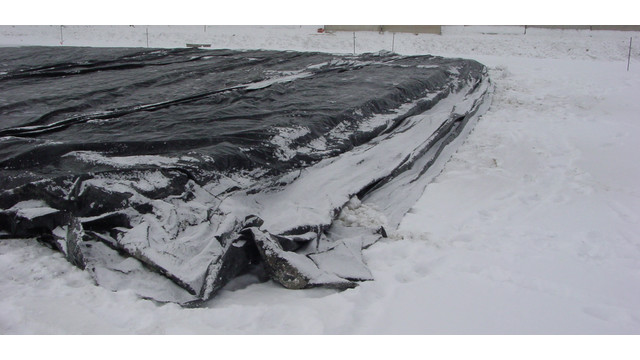
When ambient conditions allow, concrete's most straightforward cold-temperature protection is to shield it from the wind while trapping enough heat from its hydration to maintain the desired temperature. Insulating blankets spread over slabs on grade or wrapped around columns and walls are efficient and cost-effective, and insulated formwork can reliably protect walls and columns from cold damage.
Installation of a slab on grade can encounter issues if the soil subgrade is frozen. Water in the soil mass expands when frozen and disrupts the degree of compaction of the soil, especially in fine-grained soils. Thermal blankets, hydronic heaters, or forced air heaters under tarps can prevent freezing or thaw frozen subgrades. Damaged soil must either be removed or recompacted to the required density before concrete placement in areas that have been thawed after freezing.
For elevated structural elements, temporary heated enclosures can maintain temperatures high enough to allow hydration to continue normally. If combustion heaters are used, they must be vented to the outside to prevent carbonation damage to the concrete and protect workers from injury due to CO2 exposure. Rapid water evaporation from an exposed concrete surface can cause serious shrinkage cracking and should be prevented using a curing membrane or a saturated covering.
Concrete with low or partial initial loading may require protection for as long as six days, depending on air temperatures and whether the concrete uses accelerated-set admixtures. At the end of the protection period, insulating materials should be removed gradually under favorable ambient temperatures. Rapid changes in temperatures could cause thermal shock and promote temperature cracking.
Tracking Strength Development in Protected Concrete
The protection period for structural concrete designed for loading when the formwork is removed is controlled by in-place strength, not time. These elements may be subject to strength evaluation using in-place nondestructive testing or concrete maturity methods at the discretion of the structural engineer.
ASTM C31 standard test cylinders are cured in laboratory conditions to evaluate the delivered concrete strength. In the past, a separate set of compressive strength cylinders might have been cast and left to field-cure in the same conditions as the structure. ACI now discourages this practice because the test results do not correlate well with the in-place strength of the structure. Large variations in mass mean that there is a substantial difference in strength development between the structure and the test samples.
ASTM C873 offers a method to cast cylindrical strength test specimens into the body of the concrete mass, but it is only effective in a limited range of horizontal slab types. ASTM C1074, "Estimating Concrete Strength by the Maturity Method," is a proven and cost-effective approach for comprehensively evaluating in-place concrete. Temperature monitoring becomes a part of observing overall strength development, not a separate task. Concrete maturity instrumentation is widely available, easy to set up, and provides strength estimates of the structure in minutes.
Air-entrained concrete with an early age strength of 500psi (3.4MPa) will withstand a single freeze-thaw cycle without damage. When compressive strength reaches 3,500psi (24.1MPa), the concrete can withstand multiple freeze-thaw cycles without immediate damage.
We hope this article has helped you understand how proven cold weather placing, protection, and testing measures can produce high-quality structures and pavements when conditions are not ideal.
Additional Resources
The Automation Revolution: Concrete Compression Machines
Concrete Cylinder Testing - From the Field to the Lab
Gilson Is Here to Help
Contact our testing experts for more information or to discuss your testing application.
Testing Resources
Standard Test Methods, Specifications, and Practices
Individual test methods and specifications referenced in our product descriptions, blog articles, and videos are available for review or purchase from the professional organizations noted.
- ASTM International (American Society for Testing and Materials)
- AASHTO (American Association of State Highway and Transportation Officials)
- ACI (American Concrete Institute)
- State DOTs (Departments of Transportation)
- ISO (International Organization for Standardization)
- BS (British Standards)
- EN (European Standards)