

Search
Filters
Close
RSS

Blog posts tagged with 'Concrete Testing'

Have questions about your materials testing equipment?  We have the answers to these questions and much more right here! Check back monthly for long-form blog posts, how-to guides and infographics. We’ll address industry insights, the operation and maintenance of specific equipment, and our product line recommendations, all designed to better serve you.

Bookmark this page, add it to your RSS reader, or subscribe to our newsletter, so you never miss a hot topic.

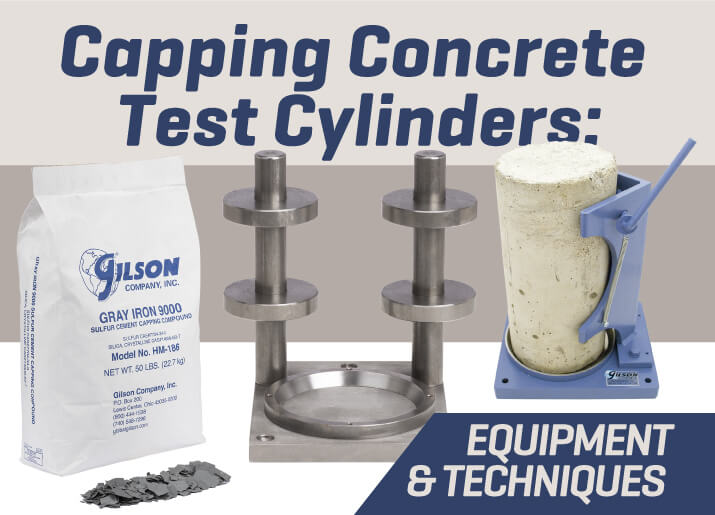
Sulfur Capping Concrete Test Cylinders: Equipment & Techniques

The two most popular types of end treatment for cylindrical concrete specimens are sulfur mortar capping and neoprene compression pads. Both have their advantages. Neoprene pads are convenient and reusable many times over. Sulfur mortar is economical when testing large numbers of cylinders, and is often the preferred end treatment for cylinders because of its long history of use. Reliable strength results and consistent display of fracture patterns are predictable and well understood. In this article, we go over the equipment and techniques used for sulfur mortar capping.

Alkali-Silica Reaction (ASR) in Concrete Explained

Although Alkali-Silica Reactivity (ASR) has created problems in concrete mixtures for centuries, the mechanism was not understood and documented until the mid-1930s. ASR is now recognized as a significant cause of concrete deterioration anywhere in the world where siliceous aggregates are found. In this blog article, we discuss what ASR is, the effect it has on concrete, prevention, and the equipment to use for testing.

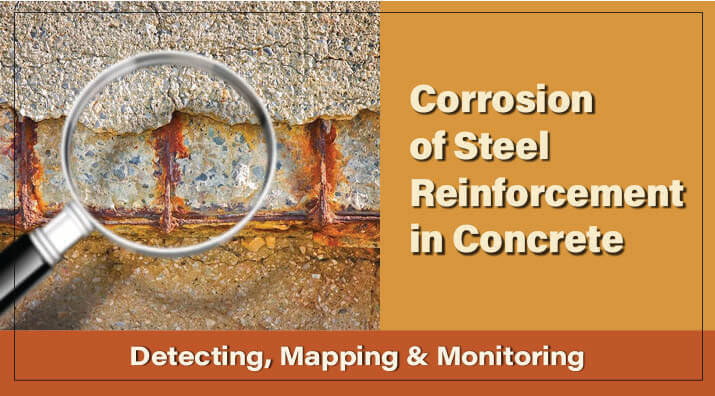
Corrosion of Steel Reinforcement in Concrete: Detecting, Mapping, and Monitoring

The corrosion of reinforcing steel is a significant and preventable problem that shortens the useful lifespan of concrete structures. The mechanisms for its development and how it eventually damages the concrete structures it was designed to protect have been well-known for over 100 years. Similar to progressive disease, early detection and monitoring are the most effective strategies to minimize problems. Fortunately, innovative nondestructive instruments are making it easier and more efficient to find, follow, and repair corrosion before extensive damage occurs.

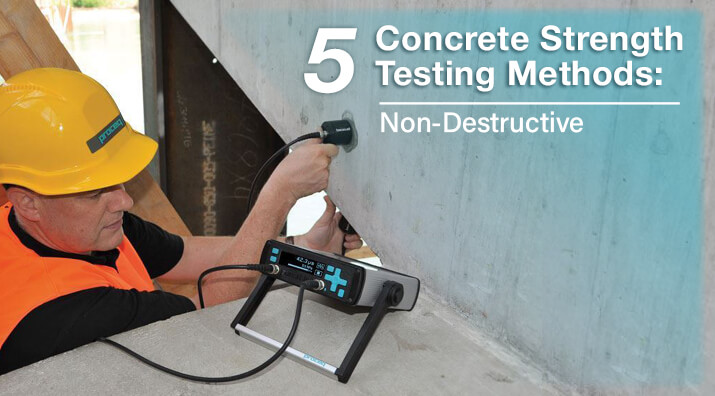
5 Concrete Strength Testing Methods – Non-Destructive

Testing the properties of hardened concrete is central to evaluating a structure, whether it is decades old or still under construction. In-place testing of concrete is a significant part of assessing an existing structure's safety and physical condition for routine maintenance before modifications. This blog post will discuss in-place and nondestructive methods and equipment to measure concrete strength.

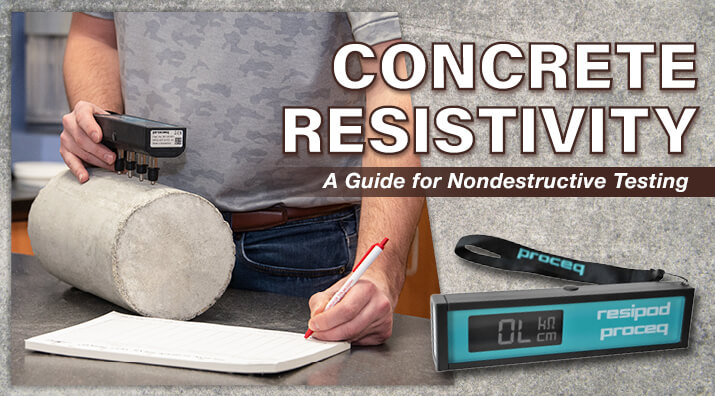
Concrete Resistivity: A Guide for Nondestructive Testing

This blog post provides insight into test methods and testing equipment for use in concrete resistivity testing. We discuss the use of the Proceq Resipod Concrete Resistivity Meter for surface resistivity and how to perform bulk resistivity.

Concrete Moisture Testing: What Equipment Works for Your Application?

The amount, type, location, and movement of moisture in a concrete slab need to be clearly understood to avoid problems when placing a flooring system over it. In this blog, we take a look at the various methods and equipment to use for testing concrete for moisture.

Concrete and Asphalt Core Drilling: When, Why, and How

This blog post will focus on the core drilling method and the core sampling equipment. We discuss why and how core samples are taken from asphalt and concrete. Lastly, we touch on some of the different lab tests performed.

Concrete Cylinder Testing - From the Field to the Lab

In this month's blog post we will focus on standard-cure cylinders made for compressive strength acceptance testing. Including the importance of cylinder testing, a quick guide on the procedure, and the equipment needed in the field and lab.

Concrete Crack Measurement Techniques and Equipment to Use

Cracks in concrete are so common that they're practically inevitable. The good news is, not all of them are bad. The bad news is, sometimes it's hard to tell the difference. In this blog post, we will discuss how best to measure and monitor cracks and select the best equipment for the job.

Cement Testing Resource Guide: Methods & Equipment

"…[Hydraulic] cement can't be characterized as just one material."

In this blog, we discuss what specifications define hydraulic cement and their use, as well as test methods and which testing equipment to use for your test application.