


History, Operation, and Use of the Superpave Gyratory Compactor
The Superpave Gyratory Compactor (SGC) for asphalt mix design evolved from the Strategic Highway Research Program (SHRP), funded by the U. S. Congress in 1987. The Superpave® pavement design method is driven by the selection of asphalt binder and aggregate blends based on their performance under local environmental and traffic conditions. Performance-based selection of amounts and types of asphalt binders and aggregate gradations allows the design of cost-effective asphalt pavements matched to local environmental factors and actual road use.
Early Breakthroughs in Gyratory Compaction
As far back as the late 1930s, it was widely known that asphalt test specimens compacted using Marshall or Hveem methods lacked the same density and void structure characteristics as drilled cores recovered from existing asphalt pavements. In early efforts to close this gap, researchers in Texas found that specimens compacted with gyrating or kneading actions instead of impact energy more closely replicated pavement samples exposed to real-world traffic loads and climatic conditions.
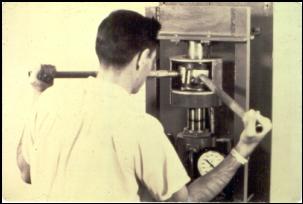
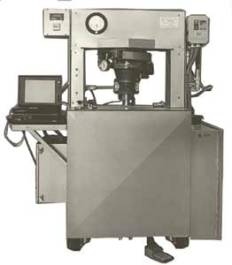
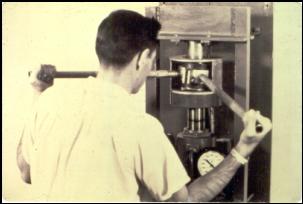
U.S. Corps of Engineers Gyratory Kneading Compactor, Source
Several notable methods and devices emerged from these initial investigations into gyratory compaction:
- The Texas Gyratory Press was developed in 1939 and adopted into Texas Highway Department standard test methods in 1946. The gyratory angles of the molds on early versions of the device were manually induced by the technician. The high 6° compaction angle achieved compaction too quickly, not allowing sufficient time to evaluate sample compactability.
- John McRae, with the U. S. Army Corps of Engineers, patented his Gyratory Test Machine (GTM) in 1957. The gyratory angle of the mold was variable and "floated" throughout the compaction cycle from 0° to 3°. The GTM was initially noted as an effective method for fabricating and testing asphalt samples, but issues of portability and cost limited its potential for widespread use.
- A French version of the gyratory compactor was developed at the Laboratoire Central des Ponts et Chaussées (LCPC) using a fixed, 1° external mold wall angle and a compaction pressure of 600kPa. Similar design features were explored in early versions of the gyratory asphalt compactor.
Unified Design Backed by Federal Funding
The Federal Highway Administration (FHWA) commissioned a demonstration project in 1990 to present and review research findings using these gyratory compactors. In 1991, a prototype compactor was produced that mitigated the size and cost handicaps of the GTM and reduced the high mold angle issues of the Texas Gyratory Press.
After the prototype was tested with various asphalt mix designs and modified for improved performance, specifications and tolerances were established for production units. Pine Test Equipment, an early and active participant in the research, design, and development of the SGC, was one of two manufacturers selected by FHWA to produce a first-article unit for evaluation.
Asphalt samples compacted on the early Pine gyratory machine closely correlated with samples from the modified Texas gyratory unit that served as the design basis. Material upgrades were made to the competing unit so that it also produced specimens within the allowable precision of AASHTO T 166. All modern Superpave Gyratory Compactors can trace their origins back to these early units.
Ironing Out the Angles
As additional SGC production models from other manufacturers were introduced, significant differences arose around the determination of the desired 1.25° external angle of gyration between different models. External angle measurements are determined by measuring the position of the mold's outer surface in relation to the frame of the compactor. Frames from various manufacturers deflect differently and may produce variable external angle measurements in response to the same loads.
It was found that measuring the gyration angle of the internal wall of the mold to the end plate produced results that were more consistent between compactor brands. To this end, standard test methods AASHTO T 312 and ASTM D6925 now specify the requirements for gyratory compaction:
- 600kPa (87psi) vertical consolidation pressure
- 1.16° internal angle of gyration
- 30 gyrations per minute
Most leading manufacturers of gyratory compactors and some third-party producers offer equipment to verify the height, force, and external gyratory angle of their own SGCs or other popular models.
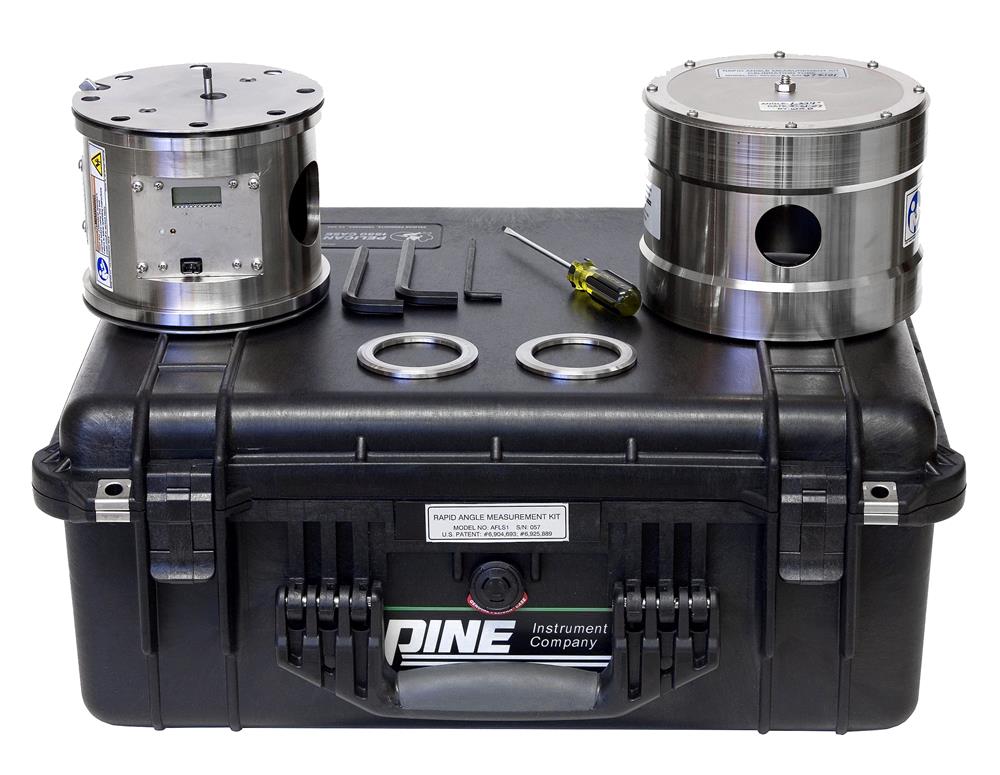
Standard test methods AASHTO T 344 and ASTM D7115 detail the requirements for measuring the internal angle of gyration. The Rapid Angle Measurement (RAM) Device quickly and easily measures this angle for any SGC simply by placing the device inside the mold and briefly operating the compactor for a few gyrations.
What Makes a Compactor an SGC?
The compactive effort applied by the Superpave Gyratory Compactor is a hydraulically induced kneading action, similar to the forces of rolling compaction equipment on hot asphalt materials during paving operations. The compactor applies vertical pressure to an asphalt trial mix sample inside a cylindrical steel mold to simulate these forces. While the sample is under load, the SGC simultaneously gyrates the mold around its longitudinal axis. The top and bottom platens in the mold remain parallel to each other during compaction.
Asphalt Tests & Sample Preparation: The SGC is a 2-in-1 Device
To design an asphalt paving mix, selections for performance-graded (PG) binder type and aggregate gradations are made based on expected traffic loads and environmental conditions. Several trial mixes are batched with binder contents at, above, and below the predicted optimum. Test results from theoretical maximum specific gravity (Gmm or Rice test) and bulk specific gravity tests (Gmb) are used to determine volumetric properties like air void content (Va) and voids in mineral aggregates (Vma) values. The chart below notes some test methods used to evaluate Superpave mix designs.
Superpave Tests for Asphalt Mix Design
| Test Description | ASTM Method | AASHTO Method | Testing Equipment |
|---|---|---|---|
| Gyratory Compaction | D6925 | T 312 | Superpave Gyratory Compactors |
| Theoretical Maximum Specific Gravity | — | T 209 | Asphalt Maximum Specific Gravity |
| Asphalt Bulk Specific Gravity (SSD) | — | T 166 | Specific Gravity Accessories |
| Asphalt Bulk Specific Gravity (Paraffin Coated) | — | T 275 | Specific Gravity Accessories |
Sensors on the SGC measure and control vertical pressure, specimen height, angle of gyration, and gyration speed during compaction. Sensor data is compared to the number of gyrations at three separate points during compaction to establish characteristics of the asphalt mix. The number of gyrations required at each stage for a mix design is specified in AASHTO R 35 for Superpave volumetric mix design and is based on estimated 20-year traffic loads.
- Ninitial: Compactability of the mix is estimated at this number of gyrations and establishes how easily and efficiently the asphalt can be placed and compacted during paving operations. Low air voids at this point could signal an unstable mix under traffic loads or that the mix may contain too much natural sand.
- Ndesign: The number of gyrations required to duplicate the expected density of the mixture in the field. An air void content of 4% is ideal at this point.
- Nmax: The density of the trial mix at this number of gyrations should not be exceeded in the actual pavement. If there are less than 2% air voids at this level of compaction, it could be a sign that the mix will compact too much under wheel loads and may eventually exhibit rutting in service.
When volumetric properties are to be determined, compaction continues for the specified number of gyrations. When the specimens are to be used to determine density or other physical properties, compaction is stopped when the sample reaches the specified height.
Here to Stay: Superpave and the Superpave Gyratory Compactor
Today, Superpave is the most-used design method for asphalt pavements across the United States and in many developed countries. Gyratory compactors are widely used to create and validate mix designs for asphalt pavements and for quality control throughout asphalt production and paving operations.
Numerous testing equipment manufacturers produce one or more gyratory compactor models, as well as a variety of other testing equipment based on Superpave methods and specifications.

Gilson Picks Two of the Best
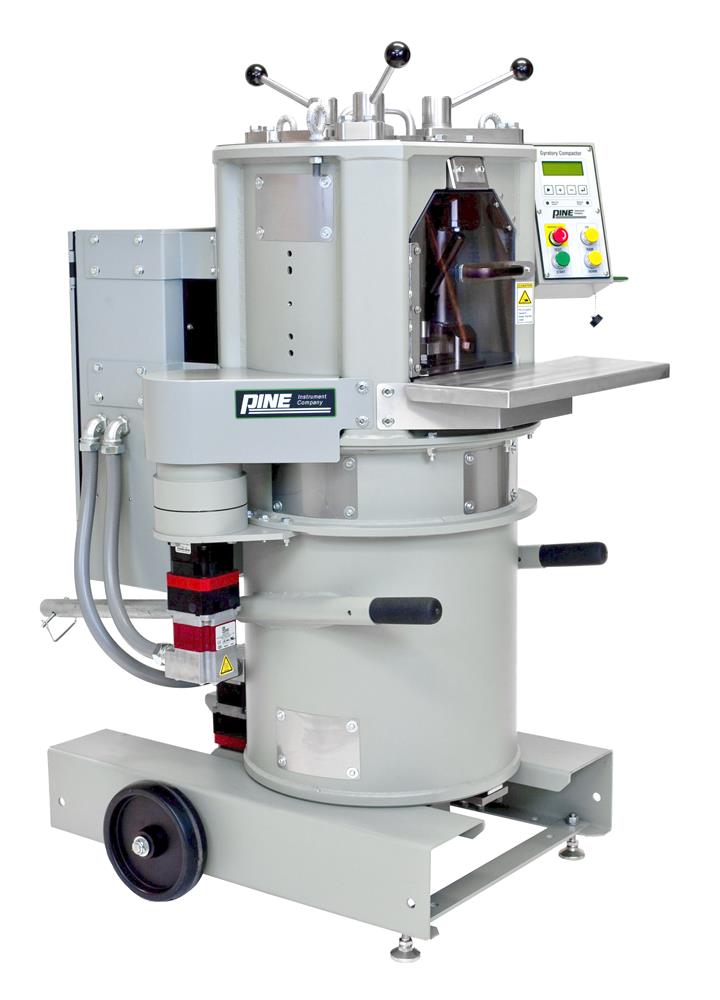
Gilson offers two gyratory compactor models, both manufactured by Pine Instruments, a pioneer in developing, designing, and producing high-quality Superpave products.
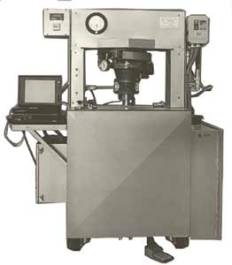
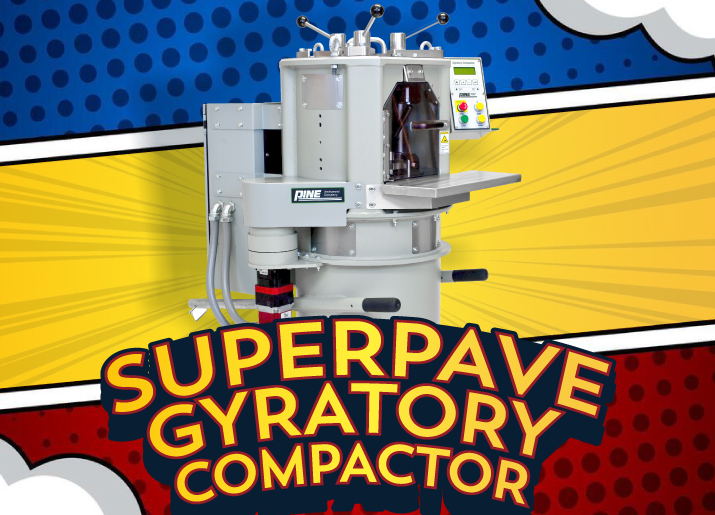
Pine Superpave Gyratory Compactor
The Pine Superpave Gyratory Compactor is a versatile and robust unit that is well-suited for laboratory mix designs and research studies that involve configurations beyond standard test methods. The speed and number of gyrations, internal and external angle, compaction force, and specimen height are all widely adjustable to suit a variety of applications and materials, such as soils or roller-compacted concrete. An advanced model is available that measures and records gyratory shear data to analyze the workability and compactability of asphalt paving mixes.
The integrated, network-compatible computer, four-button control panel, and intuitive menu interface simplify test setup and operation and optimize data management. A built-in sample extruder minimizes the handling of hot molds. Molds are available to compact 150mm, 100mm, or 4.0in diameter specimens.
Brovold Gyratory Compactor
The Brovold Gyratory Compactor is compact and portable, ideal for mix design or QC/QA applications in laboratories or at remote sites. The unit weighs 304lbs (138kg) and is easily repositioned in the lab on its heavy-duty casters, or transported to job sites in a pick-up or van.
The number and speed of gyrations, compaction force, and specimen height are adjustable and default to meet all AASHTO and ASTM requirements. Internal and external angles of gyration are fixed at 1.16° and 1.25° but can be factory set at 0.82° internal when ordered. Input of test parameters is set up through the menu-driven controller and display. Compaction cycle operation and data management is regulated through the integrated industrial computer. Complete data for up to ten tests is stored in memory for export to a USB flash drive or can be routed directly to a PCL printer.
At completion of the test cycle, extrusion of the sample from the 150mm diameter mold is performed using the same hydraulic ram used for compaction.
Gilson Superpave Gyratory Compactors
| Specification | HM-685 Superpave Gyratory Compactor | HM-687 Brovold Gyratory Compactor |
|---|---|---|
| Number of Gyrations | 0–999 | 0–299 |
| Speed of Gyrations | 30 ±0.5gpm | 20–40gpm (default is 30 ±0.5gpm) |
| Compaction Force | 200–999kPa | 300–600kPa (default is 600 ±18.0kPa) |
| Angle of Gyration | 0–1.50° Selectable internal/external | 1.16° ±0.02° internal, 1.25° ±0.02° external |
| Mold Dimensions | 150x250mm & 100x250mm, dia.xH | 150x280mm, dia.xH |
| Specimen Height | 0–200mm | 10–200mm |
| Communication Port(s) | (2) USB ports & RJ45 ethernet connector | Serial port, USB port, & visual display |
| Extruder | Built-in | Built-in |
| Gyratory Shear | Factory-installed in HM-685S model | Not available |
| Compaction Modes | Number of gyrations, height, & locking point | Number of gyrations & height |
| Data Acquisition | Gyration number, specimen height, angle of gyration, pressure, & gyratory shear (optional) | Specimen height, pressure, & external angle of gyration |
| Program Memory | Data for last 20 tests | Data for last 10 tests |
| Power Requirements | 115V, 50/60Hz, 12 Amp, 1ph or 230V, 50/60Hz, 6 Amp, 1ph | 115V, 60Hz, 15 Amp, 1ph or 230V, 50/60Hz, 10 Amp, 1ph |
| Net Weight | 850lb (396kg) | 304lb (138kg) |
| Product Dimensions | 34.5x35.5x54in (875x900x1,375mm), WxDxH | 30.0x21.3x55.4in (762x541x1,407mm), WxDxH |
We hope this article has helped you understand the Superpave Gyratory Compactor's background, operation, and use. Please contact the testing experts at Gilson to discuss your testing applications.
ADDITIONAL RESOURCES
Gilson Blogs
- Asphalt Mix Design Methods Compared: Hveem, Marshall, Superpave, and BMD
- Balanced Mix Design: A New Way Forward
- What is Superpave? Understanding Performance-Based Asphalt
- Specific Gravity of Asphalt Test: What Equipment Do I Need?
Learn More
Gilson Is Here to Help
Contact our testing experts for more information or to discuss your testing application.
Testing Resources
Standard Test Methods, Specifications, and Practices
Individual test methods and specifications referenced in our product descriptions, blog articles, and videos are available for review or purchase from the professional organizations noted.
- ASTM International (American Society for Testing and Materials)
- AASHTO (American Association of State Highway and Transportation Officials)
- ACI (American Concrete Institute)
- State DOTs (Departments of Transportation)
- ISO (International Organization for Standardization)
- BS (British Standards)
- EN (European Standards)