



Understanding Concrete Cracking
The unique properties of concrete make it the most indispensable construction material on earth and the second-most widely used material of any kind; only water is used more. Concrete is a composite of inexpensive, readily available raw materials that is easy to mix, transport, and place, and can be molded into nearly any useful shape. Concrete is exceptionally strong in compression and, with the addition of reinforcing steel, is suitable to resist bending or tensile loads. Mixtures can be designed to increase strength, control set times, improve flowability, or enhance a host of other properties.
Cracking is a characteristic reaction of concrete to physical, environmental, and internal forces that is normal and, at times, necessary. There are some acceptable concrete cracks, but most are cosmetically undesirable and may become a more serious problem over time. Cracking severe enough to be regarded as a structural defect means that expensive repairs or replacements must be undertaken before the structure can be put into service.
American Concrete Institute (ACI) documents make dozens of references to cracking, offer guidance on causes, prevention, and acceptability, and manage the expectations of owners, architects, and engineers. Here are just a few references:
- ACI 224.1R-07, Preface: "Cracks in concrete have many causes. They may affect appearance only, or they may indicate significant structural distress or a lack of durability. Cracks may represent the full extent of the damage, or they may indicate problems of greater magnitude. Their significance depends on the type of structure, as well as the nature of the cracking."
- ACI 207.2R-07, Section 1.3: "The measures used to control cracking depend, to a large extent, on the economics of the situation and the seriousness of cracking if not controlled. Cracks are objectionable where their size and spacing compromise the strength, stability, serviceability, function, or appearance of the structure."
- ACI 302.1R-04, Chapter 11: "Some curling and cracking (of floors and slabs) can be expected on every project."
What Causes Concrete Cracks?
The list of things that can cause concrete to crack is long, and the types of cracks in concrete vary widely. Cracking may begin soon after placement while the concrete is still plastic, be initiated during the initial stages of curing and early strength development, or commence after the concrete has reached its full design strength. Crack propagation may continue throughout the structure's life, cease once internal stresses are relieved, or stop once the concrete develops sufficient strength.
Plastic Concrete Cracking
The cracking of plastic concrete falls primarily into two categories: plastic shrinkage cracking and settlement cracking.
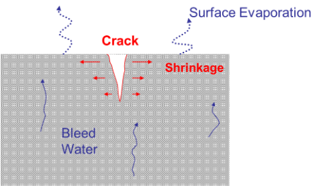
- Plastic shrinkage cracking, its causes, and steps to prevent it are discussed in detail in this previous blog post. Shrinkage cracks occur in fresh concrete when moisture evaporates from the surface faster than it can be replaced by rising bleed water. The concrete shrinks at the surface but is restrained deeper in the profile by formwork, reinforcing steel, or aggregate.
Plastic shrinkage cracks present as random and mostly shallow, with inconsistent spacing in polygonal or parallel patterns. Sizes may range from hairline cracks up to 1/8in (3mm) with lengths from a few inches to several feet or more. Plastic shrinkage is cosmetically undesirable but may not be considered a structural defect unless the cracking is severe or the surface is exposed when in service.
Plastic shrinkage in fresh concrete and drying shrinkage in curing concrete are closely related and are volume changes caused by water loss. Shrinkage cracking is a common condition, and there are simple steps to reduce the risk of it occurring. Maintaining high ambient moisture levels during curing through fogging, wet curing, and shading from heat and wind are practical mitigation measures.
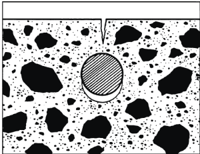
- Settlement cracking takes place soon after placement and finishing operations. Small amounts of consolidation continue as the concrete moves by gravity away from fixed elements like reinforcing steel until it is fully set. Poorly installed formwork may also allow deformation and subsequent settling.
Preventive measures include close control of the water-cement ratio and slump, proper placement and vibration, and adherence to best formwork design and installation practices.
Concrete Cracking During Initial Curing
In its initial and final set phases, concrete becomes progressively more brittle and susceptible to cracking until strength development overrides these tendencies. Different factors that cause cracking come into play. The faulty design and construction practices noted above remain an issue, but the resulting damage may be more severe and less likely to be resolved independently.
- Drying shrinkage is the volume change in concrete driven by moisture loss. It is similar to plastic shrinkage but occurs after the concrete has reached final set and may result in more severe cracking. External forces such as wind, high temperatures, and low humidity are the most common causes of drying shrinkage, but can be mitigated with wet curing, fogging, and protection from sun and wind.
- Autogenous shrinkage and carbonation shrinkage are lesser factors that cause volume reductions during this phase. These issues are due to chemical reactions and are less common than plastic or drying shrinkage.
- Chemical reactions may occur internally within concrete ingredients or admixtures. Mineral admixtures such as silica fume increase the tendency for plastic shrinkage. Shrinkage testing using ASTM C1581 should be done during the mix design phase when using these additives.
- Thermal stress caused by environmental conditions or variations in the heat of hydration during curing is a source of cracking, especially in mass concrete.
Hardened Concrete
As concrete gains strength and ages, additional conditions can trigger cracking. Here are some of the most common causes:
- Weathering and freeze/thaw cycles weaken the concrete surface, inducing and accelerating cracking. Deicing salts suspended in water permeate into the cracks and through the pore structure of the concrete, progressively increasing damage to the concrete itself and initiating corrosion of the reinforcing steel.
- Corroding reinforcing steel creates internal forces on the concrete as it undergoes volumetric expansion.
- Alkali aggregate reactivity (AAR) is a reaction between highly alkaline concrete mortar and the silica or carbonate components of the aggregate. An expansive coating forms on the surface of the aggregate particles, increasing internal stress against the concrete.
- Overloading a concrete element imposes forces beyond the designer's intent. Cracking may be the extent of the damage, or it may indicate future failure of the concrete. Once overloading occurs, the only way to predict future performance is to measure, monitor, and analyze the damage as part of an engineering investigation.
- Variations in subgrade or bearing surfaces, such as soils that subside beneath a floor slab or a foundation element, alter structural stresses and can cause cracking in unsupported concrete spans.
What to Do About Cracking
A 1/8 in (3.2mm) wide crack in part of a large foundation element might be of no particular concern, but a crack of the same size in a water retention tank would be disastrous. Hairline surface cracks on an exposed architectural surface might be completely unacceptable, but no big deal in a floor slab that gets a tile or carpet covering. Some steel-reinforced structural beams must crack on a micro scale for the reinforcing steel to pick up tensile forces and do its job.
Chapter 2 of ACI 224.1R-07 states, "Cracks need to be repaired if they reduce the strength, stiffness, or durability of the structure to an unacceptable level, or if the function of the structure is seriously impaired." A reduction in the structure's capacity or an increased likelihood of future deterioration could lead to a decision that the damage must be corrected.
Establishing the status of a crack as an acceptable anomaly or as a defect requiring repair or replacement is a process of examination and analysis. Criteria from a published chart or specification cannot be applied to each unique situation. Based on field inspections and following guidelines in the project documents, structural analysis typically follows practices noted in ACI publications, particularly ACI 224R-01.
Crack Monitors: Tools for the Job
Documenting a concrete crack's current size and location is an essential first step in investigating a cracking problem, but it can't stop there. Noting ongoing changes in the width, length, depth, and the differential between adjacent surfaces is needed to develop a complete picture of the damage. This previous blog article takes a deep dive into the equipment and techniques available for measuring and monitoring cracks.
- Preliminary field measurements collect basic information on the locations and dimensions of cracks and help decide where monitoring equipment should be placed.
- A crack width gauge or pocket comparator card are convenient for one-dimensional width measurements during an initial assessment.
- Digital calipers are helpful throughout the inspection and monitoring phases to accurately measure the width and verify changes in openings.
- For precise width measurements of finer cracks, an optical comparator or a crack-width microscope offers greater resolution.
- Tape measures are the easiest way to determine length and may be acceptable to record the width of some large cracks.
- Crack depths are difficult to measure accurately, but important to know for a complete analysis. An ultrasonic pulse velocity tester accurately measures the total depths of cracks below the concrete surface.
- Cracks must be monitored over time to accumulate enough data to determine their origins, predict their future movement, and assess their severity and potential impact on the structure.
- Wireless crack data loggers continuously monitor linear displacements in concrete and masonry structures. These electronic devices record time-stamped width and temperature values in specified intervals of as little as one minute. Data can be collected from up to 32 independent loggers for plotting and analysis.
- Crack monitors are simple devices to monitor one-dimensional changes in crack width over time. They are mounted over a crack and read periodically to track opening or closing movements.
- Displacement monitors track changes in crack width and measure differential displacement between the two sides of a crack.
Concrete Cracks: Moving on from the Damage
Once the cause, extent, and severity of cracking are established, engineers can specify appropriate actions to correct the issues. Complete demolition and replacement is one possible outcome, but certainly not desirable. Adding supplementary concrete and reinforcing or additional support to a damaged area is an option, as is crack repair using epoxy-type resins or expansive grouts. An in-depth discussion of repair procedures is beyond the scope of this article. We recommend the International Concrete Repair Institute (ICRI) as a valuable source for concrete repair guidelines and publications for cracks and other types of damage.
We hope this overview has been helpful for detecting, characterizing, and resolving cracking in concrete structures and pavements. Please contact the testing experts at Gilson to discuss your applications.
Gilson Is Here to Help
Contact our testing experts for more information or to discuss your testing application.
Testing Resources
Standard Test Methods, Specifications, and Practices
Individual test methods and specifications referenced in our product descriptions, blog articles, and videos are available for review or purchase from the professional organizations noted.
- ASTM International (American Society for Testing and Materials)
- AASHTO (American Association of State Highway and Transportation Officials)
- ACI (American Concrete Institute)
- State DOTs (Departments of Transportation)
- ISO (International Organization for Standardization)
- BS (British Standards)
- EN (European Standards)