



Thermal Imaging in NDE and NDT Projects
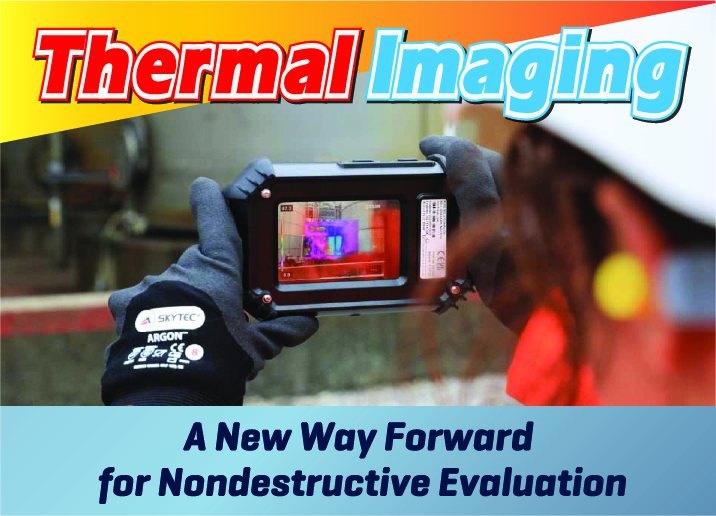
FLIR® Thermal Imaging Cameras have found an essential place in the science of nondestructive evaluation (NDE) of construction materials. Such diverse applications as bridge deck inspection, paving operations, structural void location, moisture issues, and crack detection are all made more efficient and effective when thermal cameras are used.
Humans experience and assess the world around us through our senses. Sight, hearing, touch, smell, and taste give us all the sensory input we need to navigate our environment and survive as a species. Still, our ability to detect and decode the full spectrum of sensory stimuli is limited when we rely only on our natural senses. Telescopes and microscopes greatly extend the range of our vision, sensitive microphones let us hear formerly undetectable sounds, and thermometers quantify our temperature sensitivity.
Thermal Imaging as a Tool for NDE
Effective NDE instruments extend the range of our senses and physical reach, allowing us to detect hidden issues that could affect the safety and performance of construction materials.
- Anomalies such as cracks, voids, or changes in density and moisture cannot always be detected by visual examination alone.
- Elevated structures may require using lifts, scaffolding, or harnesses for safe, up-close inspection. Implementing safe access can cause delays and add expense.
- Fresh concrete flatwork or hot asphalt paving surfaces may prevent foot traffic and impede efforts to document localized temperature profiles.
Although infrared is not visible to humans, all objects emit detectable and quantifiable heat in the infrared part of the light spectrum. Infrared (IR) thermography uses specialized sensors to measure the thermal energy objects emit. Basic infrared thermometers are widely available and display a simple digital temperature of the area they are aimed at. Infrared thermal imaging cameras are more advanced, producing and storing complete image files that clearly show temperature gradients across objects and surfaces. IR cameras are completely nondestructive and contactless; they determine temperature from a distance and render accurate images that depict hidden anomalies.
What Does a Thermal Imaging Camera "See"?
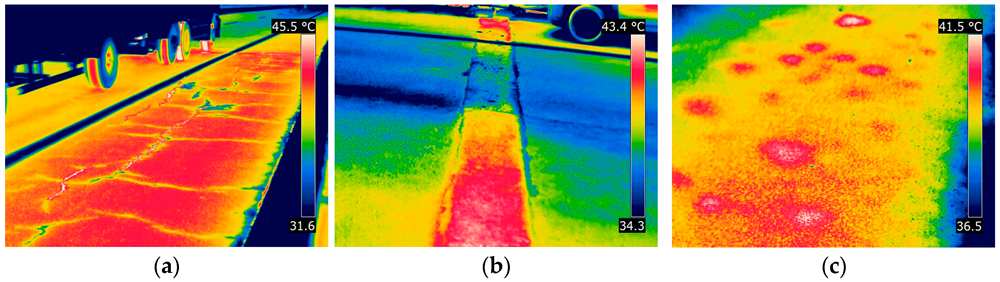
Infrared (IR) thermal imaging cameras measure thermal emissions from objects and identify gradients of infrared emissions within the heat signatures of materials. The radiation detected by the sensors is converted to visible images through the camera's integral software. Temperature gradients on material surfaces are highlighted in the images for a clear understanding of the temperature profile. The science of detecting, interpreting, and creating usable data from infrared heat energy is an impressive technology, but the actual value of these instruments lies in their presentation of the collected data in a clear visual format.
IR cameras do not measure moisture or directly detect voids in materials, but they can find temperature differentials caused by moisture or a lack of thermal mass. The cameras display images showing variations in temperature gradients that flag areas for further investigation. Thermal camera images provide data for subsequent evaluation. For construction materials testing, IR camera findings are predominantly qualitative.
The thermal camera's detection sensitivity improves when large differentials exist between night and day air temperatures and surfaces are warmed by direct sunlight. These conditions produce maximum thermal contrast between sound concrete and thinner delaminated areas. Thermal gradients are more sharply contrasted and easier to interpret on the display screen and in thermal images. Shadows cast by nearby trees and buildings can produce cooler surfaces and should be considered when analyzing images.
Practical Applications for Thermal Imaging
FLIR® IR thermal cameras are versatile instruments that lend themselves to numerous applications in construction materials testing. Besides their intended purpose of complete visual documentation of surface temperature gradients, they can replace simpler infrared thermometers or visible-spectrum cameras to record "snapshots" of works in progress. There are some projects that thermal imaging cameras are made for:
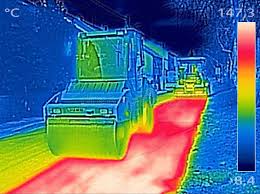
- Asphalt Paving Operations include various stages when asphalt temperatures, temperature gradients, or consistency of temperatures play crucial roles that affect the long-term quality of pavements. IR cameras provide instant insight into the range and distribution of asphalt temperatures, allowing laydown and compaction operations to be documented and guided by accurate information.
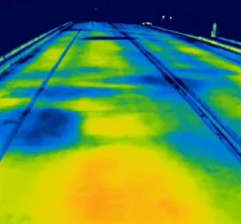
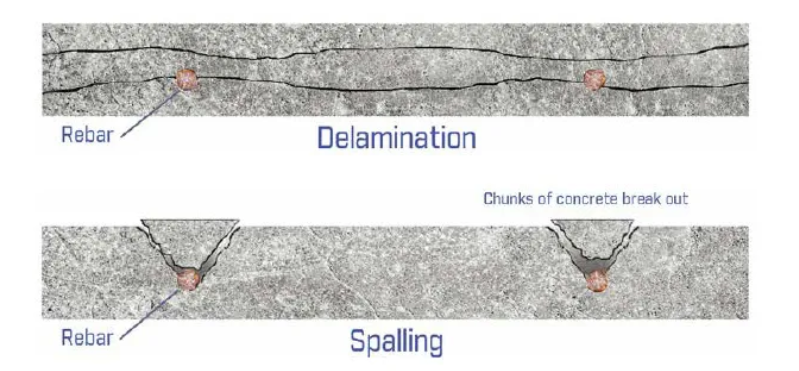
- Delamination in Concrete Bridge Decks is a common problem easily detected by thermal cameras. When moisture ingress causes expansive corrosion of the steel rebar, the forces are strong enough to produce horizontal cracking in the concrete that follows the plane of the reinforcing steel mat. This damage is invisible at first until it progresses to the point where the concrete begins to spall and disintegrate. Sounding, chain dragging, and ultrasonic pulse velocity testing are traditional strategies for early detection but require redirection or stopping of traffic and may produce inconsistent results. The IR camera safely captures instant proof of delamination from the sidelines without interrupting traffic flow. The voids formed by cracking reduce the concrete's thermal mass, and moisture may accumulate within the voids to produce a lower temperature profile in affected areas.
- Debonding of Asphalt Layers occurs in asphalt pavements with poor tack coat adhesion between lifts, water infiltration, or poor compaction. Once the layers are separated, the pavement quickly disintegrates from traffic loading. Once again, thermal cameras can quickly identify this issue because the thinner debonded area exhibits a lower thermal mass that retains less heat.
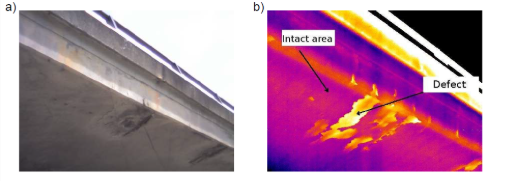
- Hidden Voids or Honeycombing in Concrete Structures become evident with thermal imaging because dense concrete retains more heat than concrete with a high void content. Thinner sections or areas with a large number of voids release their heat more readily and show up as areas with cooler temperature gradients when scanned. In some cases, moisture accumulated within the voids may cause additional cooling. While various NDT instruments can find these problems, only thermal imagery can do it remotely. Preliminary scanning with IR cameras quickly views large areas on the ground or in elevated structures without scaffolding or lift equipment. NDT testing can then be implemented in problem areas flagged by thermal scanning.
Innovative Thermal Cameras by FLIR®
FLIR® brand has pioneered the development of portable IR Cameras with state-of-the-art software that simplifies the interpretation of thermographic imagery. Simple point-and-shoot operation produces images that can be used for instant review on-site or saved for later detailed analysis. Gilson offers a complete selection of rugged and affordable FLIR handheld devices for field use.
FLIR® ONE Pro and One Pro Edge Thermal Cameras connect quickly to iOS or Android smartphones to leverage their processing power. These rugged, space-saving attachments are a cost-effective way to include high-quality IR cameras in your inspection toolkit. The units offer the performance you would expect from FLIR, with wide temperature sensing ranges and infrared, visible spectrum, and Multi-spectral Dynamic (MSX®) imaging. Data for JPEG still images or MPEG-4 video files are stored in phone memory for later analysis and reporting. The ONE Pro Edge model connects wirelessly to either iOS or Android Smartphones.
| FLIR® Model | Gilson Model | Temp. Range °F (°C) | Accuracy | Thermal Sensitivity | Thermal Resolution (Pixels) | Field of View |
|---|---|---|---|---|---|---|
| ONE Pro, iOS | MA-777 | -4° – 752° (-20° – 400°) | ±3°C or ±5% | 70mK | 160x120 (19,200) | 50°x43° |
| ONE Pro, Android | MA-779 | -4° – 752° (-20° – 400°) | ±3°C or ±5% | 70mK | 160x120 (19,200) | 55°x43° |
| ONE Pro, Edge (Wireless) | MA-771 | -4° – 752° (-20° – 400°) | ±3°C or ±5% | 70mK | 160x120 (19,200) | 54°x42° |
FLIR® TG165 Spot Thermal Camera is an affordable option, built to bridge the gap between ordinary infrared thermometers and thermal imaging cameras. The dual-laser pointers and 24:1 spot ratio enable simple, intuitive operation while producing quality thermal images with easy-to-read heat patterns. The Spot camera features selectable color palettes, MSX® imaging, and a 4GB memory to store up to 50,000 images.
| FLIR® Model | Gilson Model | Temp. Range °F (°C) | Accuracy | Thermal Sensitivity | Thermal Resolution (Pixels) | Field of View |
|---|---|---|---|---|---|---|
| FLIR® Spot | MA-769 | -13°– 572° (-25°– 300°) | ±1.5°– 3°C | <70mK | 80x60 (4,800) | 51°x66° |
FLIR® TG165 Spot Thermal Camera is an affordable option, built to bridge the gap between ordinary infrared thermometers and thermal imaging cameras. The dual-laser pointers and 24:1 spot ratio enable simple, intuitive operation while producing quality thermal images with easy-to-read heat patterns. The Spot camera features selectable color palettes, MSX® imaging, and a 4GB memory to store up to 50,000 images.
| FLIR® Model | Gilson Model | Temp. Range °F (°C) | Accuracy | Thermal Sensitivity | Thermal Resolution (Pixels) | Field of View |
|---|---|---|---|---|---|---|
| FLIR® Spot | MA-769 | -13°– 572° (-25°– 300°) | ±1.5°– 3°C | <70mK | 80x60 (4,800) | 51°x66° |
FLIR® Compact Thermal Cameras are two pocket-sized models with 3.5in (89mm) LCD touchscreens that render visible spectrum, thermal, and Multi-Spectral Dynamic Imaging (MSX®) images. Data can be transferred to the cloud or other devices through Bluetooth or Wi-Fi connections or by using an included USB-C cable. 256MB internal memory stores up to 5,000 JPEG files for further thermal analysis or reporting. An IP54 rating ensures protection from dust and water when used in challenging environments.
| FLIR® Model | Gilson Model | Temp. Range °F (°C) | Accuracy | Thermal Sensitivity | Thermal Resolution (Pixels) | Field of View |
|---|---|---|---|---|---|---|
| C3-X | MA-772 | -4°– 572°F (-20°–300°C) | 0°–100°C: ±3°C, 100°–300°C: ±3% | <70mK | 128x96 (12,288) | 54°x42° |
| C5 | MA-773 | -4° – 752° (-20° – 400°) | 0°–100°C: ±3°C, 100°–400°C: ±3% | <70mK | 160x120 (19,200) | 54°x42° |
FLIR® Ex Pro Series Thermal Cameras include four models with similar design characteristics. Pro models have a 33° x 25° field of view, a focus-free lens, and Wi-Fi connectivity for efficient report generation and image sharing. The cameras produce infrared, visual, and MSX® images for storage in internal memory. For improved visual orientation, MSX thermal image enhancement adds key visible details to the infrared images. Enhanced models feature wider temperature ranges, increasing pixel resolution on the 3.5in color display screen, and greater temperature sensitivity. The two top-of-the-line models also include image overlay and picture-in-picture display modes.
| FLIR® Model | Gilson Model | Temp. Range °F (°C) | Accuracy | Thermal Sensitivity | Thermal Resolution (Pixels) | Field of View |
|---|---|---|---|---|---|---|
| E5 Pro | MA-775 | -4°–752° (-20°–400°) | ±2°C or 2% | <60mK | 160x120 (19,200) | 33°x25° |
| E6 Pro | MA-776 | -4°–1022° (-20°–550°) | ±2°C or 2% | <50mK | 240x180 (43,200) | 33°x25° |
| E8 Pro | MA-778 | -4°–1022° (-20°–550°) | ±2°C or 2% | <40mK | 320x240 (76,800) | 33°x25° |
FLIR® Industrial High-Temperature Thermal Camera measures temperatures as high as 1,886°F (1,030°C). Dual-laser pointers and a 30:1 spot ratio allow accurate thermal gradients to be measured and recorded from a safe distance. The 2.4in (61mm) display has selectable color palettes, Multi-spectral Dynamic Imaging (MSX®), and adjustable auto power-off. Internal 4GB memory stores up to 50,000 JPEG images that can be downloaded to a PC via the included USB cable for analysis and report generation.
| FLIR® Model | Gilson Model | Temp. Range °F (°C) | Accuracy | Thermal Sensitivity | Thermal Resolution (Pixels) | Field of View |
|---|---|---|---|---|---|---|
| TG297 | MA-869 | -13°–1,886° (-25°–1,030°) | 1.5°– 3°C | <70mK | 160x120 (19,200 pixels) | 57°x44° |
We hope this article has helped you understand the value of incorporating thermal imagery into your NDE and NDT projects. Please contact the construction material testing experts at Gilson to discuss your applications.
Gilson Is Here to Help
Contact our testing experts for more information or to discuss your testing application.
Testing Resources
Standard Test Methods, Specifications, and Practices
Individual test methods and specifications referenced in our product descriptions, blog articles, and videos are available for review or purchase from the professional organizations noted.
- ASTM International (American Society for Testing and Materials)
- AASHTO (American Association of State Highway and Transportation Officials)
- ACI (American Concrete Institute)
- State DOTs (Departments of Transportation)
- ISO (International Organization for Standardization)
- BS (British Standards)
- EN (European Standards)