



Uses, Models, and Benefits of Gilson Mechanical Marshall Compactors
Some effective and time-honored construction material tests may eventually encounter a unique problem: the apparatus initially developed for the test fails to evolve to keep pace with current design trends in testing equipment. As long as the test results are presumed to be acceptable, complacency sets in, and little thought is given to modernizing and improving the safety, efficiency, or ergonomics of the testing machine.
Mechanical asphalt compactors that prepare samples for Marshall stability and other tests are not complicated. Still, there have not been many attempts to upgrade them or add useful features. Users and manufacturers alike have accepted decades-old designs as the best versions that could be produced.
What Would a Better Mechanical Marshall Compactor Look Like?
Many Marshall compactors available today can produce acceptable test values, but they fall far behind modern benchmarks for safe and reliable testing equipment. Moving parts are not shielded for worker protection, noisy mechanisms are prone to malfunctions and stoppages, and outdated controls allow inaccurate drop heights and blow counts.
Shortcomings like that don’t align with Gilson’s philosophy or product standards, so our design team went to work to build a better compactor. Our new series of Mechanical Marshall Compactors meets our standards for safe, accurate, and reliable laboratory equipment.
Do We Need a New Marshall Compactor?
While Superpave performance-based asphalt design methods now predominate in the United States for state and federal highway projects, empirical Marshall methods continue to play a significant role in local roadways and lower-traffic applications. Marshall compaction also produces asphalt test specimens used in various laboratory tests. Marshall stability and flow specimens are obviously at the top of the list, but other, newer test methods also use the Marshall compactor to prepare their test specimens.
Asphalt Tests That Require Marshall Specimens
| Test Description | ASTM | AASHTO |
|---|---|---|
| Preparation of Asphalt Mixture Specimens Using Marshall Apparatus | D6926 | R 68 |
| Stability & Flow of Asphalt Mixtures (4in Specimens) | D6927 | T 245 |
| Stability & Flow of Asphalt Mixtures (6in Specimens) | D5581 | T 245 |
| Effect of Moisture on Asphalt Concrete Paving Mixtures | D4867 | T 283 |
| Indirect Tensile (IDT) Strength of Asphalt Mixtures | D6931 | — |
| Asphalt Tack Coat Interlayer Shear Strength | — | TP 114 |
| Compressive Strength of Bituminous Mixtures | D1074 | T 167 |
| Effect of Water on Compressive Strength of Compacted Bituminous Mixtures | D1075 | T 165 |
| Asphalt Mixture Cracking Resistance using the Semi-Circular Bend Test (SCB) | D8044 | T 393 |
| Rutting Tolerance Index of Asphalt Mixture Using the Ideal Rutting Test | D8360 | — |
How Marshall Asphalt Compaction Is Done
Conventional Marshall compaction methods involve placing a prepared sample of loose, heated asphalt mixture in an asphalt compaction mold and spading it into place with a heated spatula. The filled mold with a circular paper disc on each end is positioned in a mold holder on the compaction pedestal. The sample is manually or mechanically compacted using a guided drop hammer, with the required number of hammer blows applied. The mold is removed and inverted, and the same number of blows is applied to the reversed surface.
The number of blows is typically set at 35, 50, or 75, based on the anticipated traffic load for the pavement. Most mechanical compactors deliver hammer blows at a rate of 64 BPM; however, some models are available that operate at a rate of 55 BPM to satisfy the requirements of certain standard test methods.
What Sets Gilson Marshall Compactors Apart?
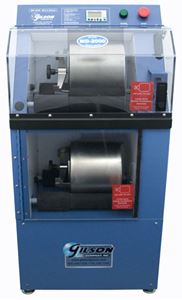
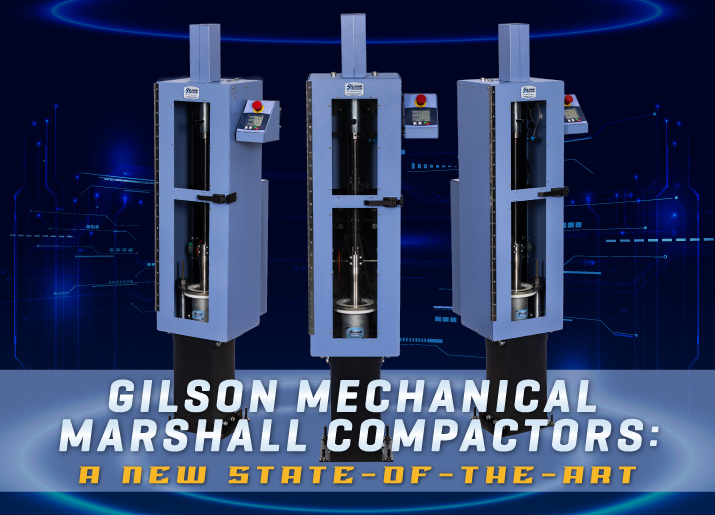
The most striking feature of Gilson’s Mechanical Marshall Compactors is the fully enclosed compaction mechanism. This safety enclosure shields all moving parts and potential pinch points while ensuring easy access for placement and handling of sample molds and maintenance. A safety interlock switch prevents operation unless the door is securely latched.
The MDF engineered wood housing also reduces noise from the mechanism and the impact of compaction. The enclosure features heavy-duty construction with a sturdy, full-length steel hinge. An adjustable over-center latch secures the door against the housing for a tight closure. Clear Lexan® windows allow easy observation of compactor operation while restraining flying debris.
A powerful ¾ hp electric motor lifts the compaction hammer to the specified 18 in (457.2 mm) drop height and rotates the mold on designated models for even distribution of hammer blows. The electronic controller can be programmed to deliver up to 999 blows to the sample, and automatically shuts off after the specified count is reached. Both the programmed and current blow counts are displayed during operation. A large red emergency stop button on the controller instantly shuts down the compactor in the event of safety concerns.
Gilson’s unique EZ-Clamp system securely anchors sample molds for compaction yet makes it easy to remove and replace them. Simply press the buttons on the EZ-Clamp knobs to release the top stabilizer plate for removal. After positioning the mold on the compaction pedestal, reinstall the top plate by pressing the buttons again and give the knobs a quick twist to lock down the assembly.
Stainless-steel hammer assemblies with either flat-face or bevel-faced designs are readily removed and replaced for required preheating on hotplates or in ovens before compaction. Additional hammer assemblies are optionally available to optimize testing efficiency. Stainless steel construction eliminates corrosion concerns and makes the components easy to keep clean.
MS-54 and MS-56 Compactor models are designed for simple conversion between the production of either 4in or 6in (102mm and 152mm) diameter specimens. The optional Conversion Kits include the appropriate bevel-faced hammer and rotating mold assembly.
Gilson Mechanical Marshall Compactors
| Model | Stationary Base | Rotating Base | Mold Size (in) | Blows Per Minute | Hammer Type | Hammer Mass (lb) |
|---|---|---|---|---|---|---|
| MS-53 | X | — | 4 | 55 | Flat-Face | 10.0 |
| MS-52 | X | — | 4 | 64 | Flat-Face | 10.0 |
| MS-54 | — | X | 4 or 61 | 64 | Bevel-Face | 10.0 or 22.5 |
| MS-56 | — | X | 6 or 42 | 64 | Bevel-Face | 22.5 or 10.0 |
Marshall Compaction Molds are available in 4in (102mm) diameter stationary or rotating versions or 6in (152mm) diameter rotating versions as complete assemblies. Individual mold, base plate, or collar components are also available separately for more efficient sample preparation operations.
Molds for Gilson Mechanical Marshall Compactors
| Description | Model | Diameter | Compactor Type | Mechanical Compactor Compactibility1 |
|---|---|---|---|---|
| Complete Assembly | MSA-100 | 4in (102mm) | Stationary | MS-52, MS-53 |
| Mold | MSA-100M | |||
| Collar | MSA-100C | |||
| Base Plate | MSA-100B | |||
| Complete Assembly | MSA-101 | 4in (102mm) | Rotating | MS-54 |
| Mold | MSA-100M | |||
| Collar | MSA-100C | |||
| Base Plate | MSA-101B | |||
| Complete Assembly | MSA-106 | 6in (152mm) | Rotating | MS-56 |
| Mold | MSA-106M | |||
| Collar | MSA-106C | |||
| Base Plate | MSA-106B |
1Inquire about compatibility with compactors from other manufacturers.
We hope this article has helped you understand the advantages and features of the new Gilson Mechanical Marshall Asphalt Compactors. Please contact our testing experts with questions or for help with your application.
Additional Resources
Blogs
- The Marshall Test Method: Everything You Need to Know
- Asphalt Mix Design Methods Compared: Hveem, Marshall, Superpave, and BMD
Videos
- Gilson Marshall Compactors
- Gilson Asphalt Testing Equipment
- Marshall Stability Load Frame
- Marshall Breaking Heads
Products
- Asphalt Marshall Testing Equipment & Accessories
Gilson Is Here to Help
Contact our testing experts for more information or to discuss your testing application.
Testing Resources
Standard Test Methods, Specifications, and Practices
Individual test methods and specifications referenced in our product descriptions, blog articles, and videos are available for review or purchase from the professional organizations noted.
- ASTM International (American Society for Testing and Materials)
- AASHTO (American Association of State Highway and Transportation Officials)
- ACI (American Concrete Institute)
- State DOTs (Departments of Transportation)
- ISO (International Organization for Standardization)
- BS (British Standards)
- EN (European Standards)