



Importance & Benefits of Concrete Density Tests
In a previous Gilson blog article, we discussed the importance of performing a complete battery of tests when a sample of fresh concrete is taken. It can be tempting to run just slump, air, and temperature tests and make a set of cylinders or beams if that’s all the job specifications call for, but is that what’s best in the long run? After all, you only get one chance to perform tests on a batch of fresh concrete.
When making strength specimens for acceptance testing, ASTM C31 / AASHTO R 100 standard practices require that slump, air content, and temperature must also be performed. Currently, a non-mandatory note in both practices states that some specifications may also require the determination of the density (unit weight) using the C138 / T 121 test method.
Why Bother with One More Test?
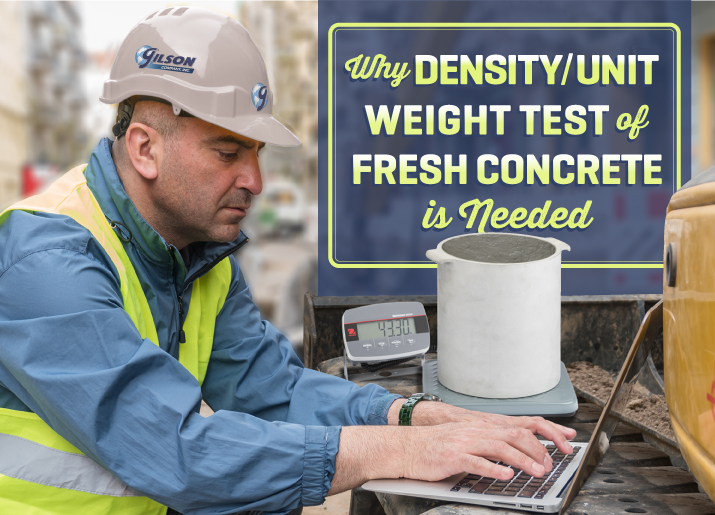
The density test is easy to perform during conventional fresh concrete tests. Calculations using test results and batch weight data supplied by the plant confirm that the specified mix design has been delivered and reveals several other important characteristics. The equations used to calculate these properties are detailed at the end of this article.
Theoretical Density
Theoretical Density is a value calculated from batch weights and volumes that does not account for air content. It can be used with the measured field density to calculate the percentage of air.
Yield
Yield is the volume of freshly mixed concrete in cubic yards or cubic meters produced from known quantities of ingredients. Yield is calculated by dividing the total weight of all the mix ingredients by the unit weight of the fresh concrete. This value reveals the concrete volume actually delivered and can resolve disputes stemming from the volume needed vs. the volume calculated.
Relative Yield
Relative Yield compares the actual volume of concrete delivered to the designed volume and is ideally 1:1, expressed as 1.00. If the relative yield is greater than 1.00, then more concrete was delivered than ordered. If less, then less concrete was delivered than ordered. Discrepancies in yield values can result from errors in batching weights, variations in air content, undocumented changes in water content, miscalculation of required volume, or deflection of forms.
Cement Content
Cement Content by weight is calculated by dividing the total mass of cement in the batch by the yield in cubic yards or meters.
Gravimetric Air Content
Gravimetric Air Content can be calculated by one of three different equations using combinations of theoretical density, actual density, absolute volume of ingredients, and batch volume. ASTM C31 stipulates that air content values for the record must be determined by either the C173 volumetric or C231 pressure methods.
Industry Trends are Normalizing Density/Unit Weight Testing
A growing number of industry users and producers believe that unit weight/density values are so worthwhile that they should be performed whenever strength specimens are made. Many testing labs are already conducting the test whenever samples for cylinders or beams are taken. Some agencies still have concerns about the added time, effort, and expense of including unit weight checks with the “regular” fresh concrete tests, but when all factors are considered, these issues are not as restrictive as they seem.
Test method requirements for scoops, tamping rods or vibrators, strike-off plates, and mallets are all the same for the slump, air, density tests, and strength samples of the most common concrete mixes. Often, a suitable field scale is the only additional equipment needed to perform the unit weight test.
Integrating Density Tests into Your Testing Routine
For concrete mixes using normal-weight or dense aggregates with a nominal maximum size of 1in (25mm), it is already common practice to perform the C138 density test using the 0.25ft³ (7.08L) measuring bowl of an ASTM C231 Type A or Type B concrete air (pressure) meter. Sampling, consolidation, and strike-off procedures for density and air tests are nearly identical, so the same sample can be used for both tests. The density test requires a strike-off plate instead of a flat bar, but the air content test allows either device to be used.
Once the concrete sample is consolidated and struck off, and the mass of the filled bowl is recorded, the cover assembly of the air meter is clamped in place, and the test for air content proceeds. The only additional time added to the sequence is for weighing the filled unit weight measure. Following the steps outlined in C231, water is added to the air meter assembly to displace free air, and the sample is pressurized. Since water is added at this point, density and air tests must be performed in order, and the sample must be discarded after completion.
Unit Measure Capacity for Maximum Coarse Aggregate Sizes
| Nominal Maximum Aggregate Size, in (mm) | Minimum Measure Capacity, ft³ (L) |
|---|---|
| 1 (25) | 0.2 (6) |
| 1.5 (37.5) | 0.4 (11) |
| 2 (50) | 0.5 (14) |
| 3 (75) | 1.0 (2.8) |
| 4.5 (112) | 2.5 (70) |
| 6 (150) | 3.5 (100) |
Unit Weight Measures or air meter bowls with 0.25ft³ (7.08L) capacity weigh approximately 45lbs (20kg) when filled with normal-weight concrete and are manageable for most technicians to handle. Concrete mixes with larger coarse aggregate sizes call for large unit weight measures with a capacity of up to 3.5ft³ (100L) as specified by the test method. Lifting, weighing, and emptying of full unit weight measures with volumes greater than 0.25ft³ (7.08L) requires the assistance of another person or mechanical hoists or trolleys for safe handling.
Doesn’t That Mean Extra Equipment?
As noted, the specified requirements for Scoops, Tamping Rods, Rubber Mallets, and Strike-Off Plates are mostly the same across the different test methods for fresh concrete, including density/unit weight. One advantage of these uniform specifications is that a minimum number of accessories are needed to consolidate and finish fresh concrete samples. If density determinations are added to the list of routine fresh concrete tests, the only additional item needed is a reliable field scale.
Many models of mechanical or digital scales can be pressed into service to perform concrete density tests in the field, but not all are ideal for the task. As we discuss in this Gilson blog article (link when posted), the characteristics of some scales make them more suitable for use in field conditions. Traditional mechanical balances served the purpose for many years but, in practice, are heavy, slow to operate, and easily damaged. Gilson recommends Digital Field Scales from A&D, Ohaus, and Adam Equipment.
What Properties Does the Density Test Determine?
Using the results of the Density/Unit Weight test combined with batch weights provided by the concrete supplier, several essential properties of the fresh concrete sample can be calculated. The properties and mathematical equations are listed below.
Density (Unit Weight)
D = (Mc – Mm) / Vm
Theoretical Density
T = M / V
Yield
Y(yards3) = M / (D x 27)
or
Y(meters3) = M / D
Relative Yield
Ry = Y / Yd
Cement Content
C = Cb / Y
Gravimetric Air Content
A = [(T – D) / T] x 100
or
A = [(Y – V) / Y] x 100 (SI units),
or
A = [(Yf – V) / Yf] x 100 (inch/pound units)
Where:
A = air content
C = actual cement content
Cb = mass of cement in the batch
D = density (unit weight)
M = total mass of all materials
Mc = mass of the measure filled with concrete
Mm = mass of the measure (tare)
Ry = relative yield
T = theoretical density of the concrete, air-free
Y = yield
Yd = design yield>
Yf = volume of concrete produced per batch
V = total absolute volume of ingredients in the batch
Vm = volume of the measure
We hope this article on the Density/Unit Weight test for fresh concrete has provided some guidance in understanding the test and its benefits. For help with your particular application, please contact the Testing Experts at Gilson today.
Gilson Is Here to Help
Contact our testing experts for more information or to discuss your testing application.
Testing Resources
Standard Test Methods, Specifications, and Practices
Individual test methods and specifications referenced in our product descriptions, blog articles, and videos are available for review or purchase from the professional organizations noted.
- ASTM International (American Society for Testing and Materials)
- AASHTO (American Association of State Highway and Transportation Officials)
- ACI (American Concrete Institute)
- State DOTs (Departments of Transportation)
- ISO (International Organization for Standardization)
- BS (British Standards)
- EN (European Standards)