





How Concrete Maturity Can Help Concrete Testing Applications
Concrete maturity is a nondestructive test method that reliably estimates concrete strength development in real time. The procedure compares the time-temperature curing history with the compressive strengths of laboratory-prepared specimens to predict the early-age strength of concrete in structures and pavements.
The temperature history of concrete, plotted over time, determines its maturity and allows reliable observations of its strength development. ASTM C1074 defines the maturity test as "a technique for estimating concrete strength based on the assumption that samples of a given concrete mixture attain equal strengths if they attain equal values of the maturity index."
Tracking Concrete Strength Development
Accurate estimates of in-place concrete strength are invaluable for implementing safe, efficient construction scheduling. The strength development of a concrete mix design can be tracked by testing multiple compressive strength specimens at prescribed age intervals. If the temperature history of the specimens is tracked at the same time, a maturity index can be established mathematically and correlated with the break tests to predict compressive strength at any age. Maturity testing allows accurate strength estimates of in-place concrete, even under radically different curing environments.
Estimating the early-age strength of concrete with the maturity method is not new. Sustained monitoring of concrete curing temperatures for strength determinations has been practiced since the 1950s, but collecting and reducing suitable time-temperature field data in those early days was cumbersome and time-consuming.
The evolution of remote electronic sensors, logging devices, and wireless data transmission has made all aspects of maturity testing more accessible and easier to implement. Modern wireless sensors embedded in the concrete use Wi-Fi, Bluetooth™, and cellular technologies to collect, compute, and report concrete maturity values to stakeholders anywhere in the world.
Concrete Maturity Testing vs Concrete Cylinders
For safety and structural integrity, newly placed concrete must achieve a reliable level of strength before operations such as form removal, reshoring of structural slabs, post-tensioning, or application of traffic loads on pavement can commence. The consequences of removing falsework or applying loads before the concrete can safely support itself range from minor damage to the disastrous collapse of the structure. Clearly, an accurate and timely method of estimating actual strength is required to undertake these critical activities safely.
Most conventional strength tests are meant to assess the quality of the concrete delivered to the project and verify that mix specifications have been met. Cylinder or beam samples molded when the concrete is delivered to the job site are cured and later tested at specific ages for compressive or flexural strength. These strength tests produce snapshots that compare current characteristics with expected development milestones.
The strength samples cure on-site for up to 48 hours under specified conditions, and final curing takes place in controlled laboratory conditions in accordance with ASTM C31. Meanwhile, the concrete placed on the project cures under a much wider range of environmental conditions. So, laboratory tests reflect the potential strength of the concrete, but the same mix placed in the structure may take longer to achieve the same strength.
By contrast, maturity testing provides reliable up-to-the-minute concrete strength information at any point during the curing process, from a few hours to 28 days or more. Form removal and reshoring work is expedited, and pavements and slabs can be put into service sooner. Advanced systems make strength data available instantly to contractors, engineers, architects, owners, or any stakeholder with authorized access.
The timeliness of form removal might also be judged on early-age tests of field-cured acceptance cylinders, a method permitted in C31. However, field-cured specimens have a much smaller mass compared to the structural concrete, and often respond differently to the same environmental conditions. Tracking concrete maturity as it approaches or exceeds its required strength provides reliable information for critical decisions regarding form removal, temporary shoring, and overall quality control.
Implementing Maturity Testing
Several standard test methods relate to concrete maturity testing procedures:
- ASTM C1074 Standard Practice for Estimating Concrete Strength by the Maturity Method
- ASTM C918 Standard Test Method for Measuring Early-Age Compressive Strength and Projecting Later-Age Strength
- AASHTO T 325 Standard Method of Test for Estimating the Strength of Concrete in Transportation Construction by Maturity Tests
- AASHTO T 276 Standard Method of Test for Measuring Early-Age Compression Strength and Projecting Later-Age Strength
Deploying maturity sensors before concrete placement is a straightforward operation. Prior to concrete placement, maturity sensors are attached to reinforcing steel bars or other embedments within the limits of the concrete placement or inside the formwork. Details of sensing and data collection instruments vary widely in design and in the type of temperature sensor used. In most cases, some portion of the sensors will remain in the hardened concrete at the conclusion of testing.
Retrieval of maturity data often requires being present at the project site to collect values via a wired or wireless connection to the sensing equipment. The Contemp Maturity System from Gilson makes data available via a direct cellular connection, eliminating costly site visits. The system also generates user-selectable temperature alarms and automatically pushes test data to the cloud.
Correlating Compressive Strength to Concrete Maturity Data
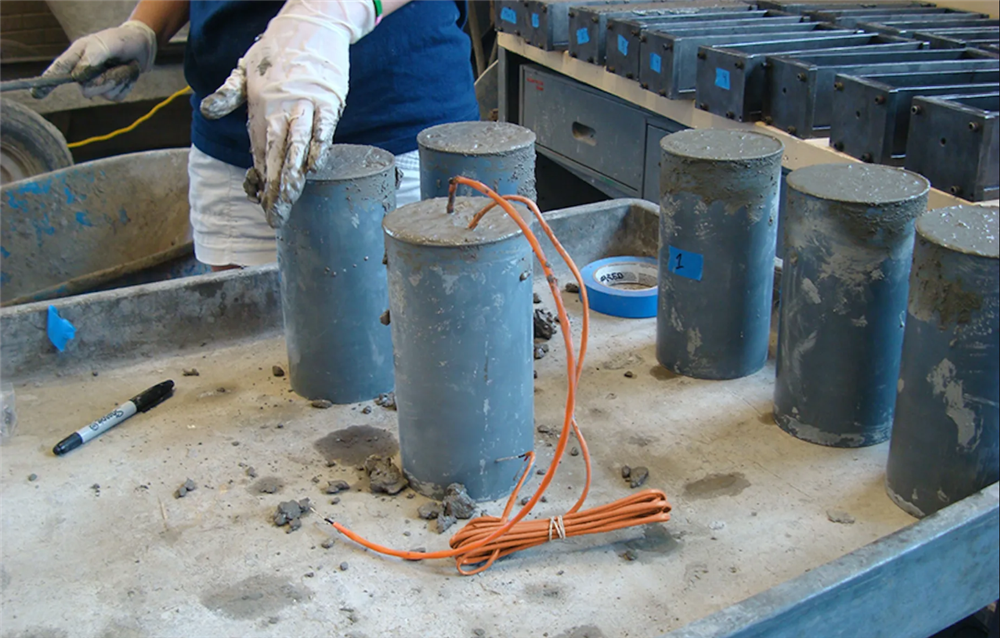
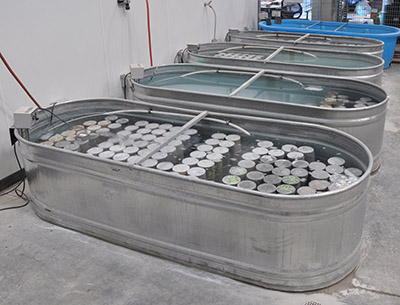
Developing a strength-maturity relationship for testing in accordance with ASTM C1074 begins with the laboratory batching and molding of at least 15 test cylinders of the same mix design as the concrete to be tested. Temperature sensors are embedded in at least two of the cylinders, and all specimens are moist-cured following ASTM C511. A non-mandatory note in C1074 states that curing the cylinders by water immersion rather than in a moist room reduces temperature variations among the specimens.
Compressive strength tests in accordance with ASTM C39 are performed on cylinders at ages 1, 3, 7, 14, and 28 days. At each test age, the maturity index is computed from the average compressive strength of the two test specimens and the temperature data from the instrumented cylinders.
The average compressive strength is plotted against the maturity index values. This strength-to-maturity relationship estimates the strength of concrete cured under differing temperature conditions.
ASTM C1074 offers two solutions for computing the concrete maturity index:
- Temperature-Time Factor: This equation assumes the rate of strength development increases linearly with temperature and that strength gain stops below the datum temperature. This formula is widely known as the Nurse-Saul equation. The relative simplicity of this equation makes it the most commonly used strength estimation method.
M(t) = ∑(Ta − T0) Δt
Where:
M(t) = the temperature-time factor at age t, degree-days or degree-hours,
Δt = a time interval, days or hours.
Ta = average concrete temperature during time interval, Δt, °C, and
T0 = datum temperature, °C.
- Equivalent Age: Based on the Arrhenius equation, this solution considers a broader range of concrete curing temperatures but is somewhat more complex to solve. It assumes an exponential increase in strength development with time.
te = ∑ e−Q ( 1/Ta − 1/Ts ) Δt
Where:
te = equivalent age at a specified temperature Ts, days or h,
Q = activation energy divided by the gas constant, K,
Ta = average temperature of concrete during time interval Δt, K,
Ts = specified temperature, K, and
Δt = time interval, days or hours.
Additional Benefits
Close tracking of concrete temperatures during hydration has benefits beyond just strength estimation. Monitoring both internal and ambient temperatures under any kind of weather conditions allows better control of strength development and enhances long-term durability.
Shrinkage, thermal cracking, and potential freezing conditions can be managed more effectively when high or low temperatures or excessive temperature differentials are detected early. Heating, cooling, or wind protection measures can be implemented sooner to avoid potential damage, future quality and durability issues, and costly rework.
Project specifications increasingly require a record of internal and ambient temperatures for concrete pours. Maturity testing satisfies these additional demands while improving the overall quality of the structural elements
Gilson Recommends the Contemp Concrete Maturity System
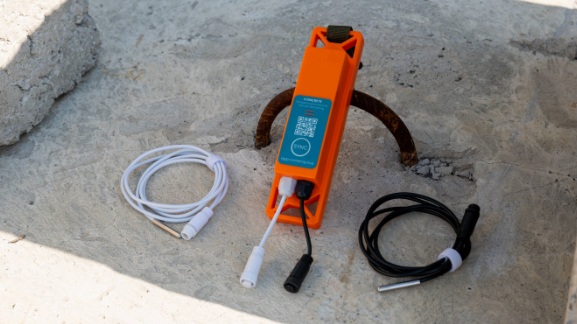
The Contemp Concrete Maturity System brings together accurate digital performance, advanced technology, adaptability, and cost-effective operation to estimate in-place concrete strength. Contemp meets all ASTM and AASHTO requirements to determine the in-place strength of concrete. The maturity index and strength estimations are calculated using the temperature-time (Nurse-Saul) equation.
The rugged and reliable recorder at the heart of the system integrates digital temperature sensors and data acquisition with cellular and Wi-Fi connectivity. The IP67 waterproof recorder automatically connects directly to LTE-M or 2G cellular networks or on-site Wi-Fi grids. There are no subscription fees, and a free, unlimited global data plan is included. A geolocation feature identifies the recorder's exact location during operation.
Compressive strength values from laboratory specimens uploaded to the recorder are correlated with collected time and temperature data to determine the maturity index and estimate concrete strength. This maturity and strength data is encrypted and stored in the cloud at specified intervals and is accessible to an unlimited number of authorized users at any time during the monitoring period. Trips to the job site solely to collect data are unnecessary. Project data is stored in a cloud folder, where reports are generated for distribution at the completion of the monitoring cycle.
The recorder simultaneously logs concrete temperatures from two separate probes at user-determined intervals. Independent maturity indices and strength estimations are calculated and stored for each probe. A third internal sensor records ambient temperature. Collectively, this system not only determines maturity and estimated strength from two locations but also tracks and calculates temperature differentials between the two probes and the ambient sensor. Alarms are sent via SMS text, email, or cellular calls when temperature variances exceed user-defined set points.
Low-cost probes are supplied with 4.9ft (1.5 m) cables for convenient pre-pour positioning. Additional 9.8ft (3M) cable extensions are available to increase the total length to a maximum of 24.6ft (7.5M). Probes are available with optional NIST traceable certification. The temperature measurement range is -67° to 257°F (-55° to 125°C). Recording intervals are selectable from 1 to 30 minutes, and the recorder syncs to the cloud at specified intervals from 10 minutes to 7 days.
We hope this article has helped you understand concrete maturity, the test method, and how it can help your concrete testing operations. Please contact the testing experts at Gilson to discuss your applications.
Gilson Is Here to Help
Contact our testing experts for more information or to discuss your testing application.
Testing Resources
Standard Test Methods, Specifications, and Practices
Individual test methods and specifications referenced in our product descriptions, blog articles, and videos are available for review or purchase from the professional organizations noted.
- ASTM International (American Society for Testing and Materials)
- AASHTO (American Association of State Highway and Transportation Officials)
- ACI (American Concrete Institute)
- State DOTs (Departments of Transportation)
- ISO (International Organization for Standardization)
- BS (British Standards)
- EN (European Standards)