






Concrete Strategies in Hot Weather Conditions
Hot weather creates significant problems for concrete placement operations, although it is not just the elevated air temperature causing issues. Wind, low humidity, and even bright sunlight often accompany hot weather, and each can negatively affect all phases of batching, transport, placing, and curing. When two or more of these factors combine, challenges multiply exponentially.
The combined impacts of temperature, relative humidity, and wind speed cumulatively have a negative effect on fresh concrete, placement, and early-age strength development. Because these components are naturally occurring weather conditions, they can be difficult to mitigate.
Strategies For Placing Concrete in Hot Weather
High-quality concrete pavements and structures can still be produced with planned, proactive measures executed in the face of unfavorable conditions. At the batch plant, watering the stockpiles cools the aggregate fractions, and including ice as a portion of the mix water significantly reduces mix temperatures. Set-retarding and water-reducing admixtures slow down set times, and supplementary cementitious materials (SCMs) like fly ash control the heat of hydration. Onsite, spraying water on formwork or subgrades takes surface temps down, and the addition of shading and wind blocks can reduce heat gain and evaporative loss.
Soon after batching, the rate of slump loss increases as high material and air temperatures accelerate hydration and evaporative water loss. If nothing is done at this point, workability, compaction, and finishing operations all suffer, and the concrete may suffer permanent damage. Adding water onsite might correct some problems but is easily overdone. Added water increases potential bleed water, aggravating plastic shrinkage cracking and handicapping long-term strength and durability.
Guidance from the American Concrete Institute (ACI)
ACI PRC-305-20 (ACI 305R), Guide to Hot Weather Concreting, from the American Concrete Institute offers comprehensive direction on mixing, delivering, placing, and curing concrete during hot weather conditions. The guide is written in informative, non-mandatory language to provide clear solutions to unfavorable conditions. 305R discusses the causes and effects of hot weather on concrete construction and offers experienced insights from the ACI 305 committee on hot-weather concreting. Section 2.2 provides a definition:
hot weather - one or a combination of the following conditions that tends to impair the quality of freshly mixed or hardened concrete by accelerating the rate of moisture loss and rate of cement hydration, or otherwise causing detrimental results: high ambient temperature; high concrete temperature; low relative humidity; and high wind speed.
ACI SPEC-305.1-14(20), Specification for Hot Weather Concreting, is a publication from the same committee, but written in mandatory language and designed for inclusion in project specifications as part of the requirements.
What Testing Agencies Should Know
Inspection and testing of concrete placements in hot weather conditions requires knowledge of specifications, an understanding of how fresh concrete reacts to varying temperatures and relative humidities, and the readiness to respond to changing site conditions. Specific responsibilities of the testing lab may vary by project, but core obligations are constant:
- Proper sampling and performing of fresh concrete tests.
- Ensuring that strength samples represent the concrete as delivered and placed, even if additional strength samples are needed.
- The strength samples must undergo initial curing under temperature and humidity requirements specified in ASTM C31/AASHTO T 23.
- Observations of conditions that might affect long-term performance must be measured and recorded.
Testing agencies should pay particular attention to the testing and inspection guidelines in Chapter 7 of ACI 305R. Section 7.1 calls for taking extra care to comply with ASTM C31 (or AASHTO T 23), Practice for Making and Curing Concrete Test Specimens in the Field. Taking steps to prevent elevated curing temperatures and moisture loss in strength specimens during the sensitive initial curing phase ensures full strength development for acceptance testing samples.
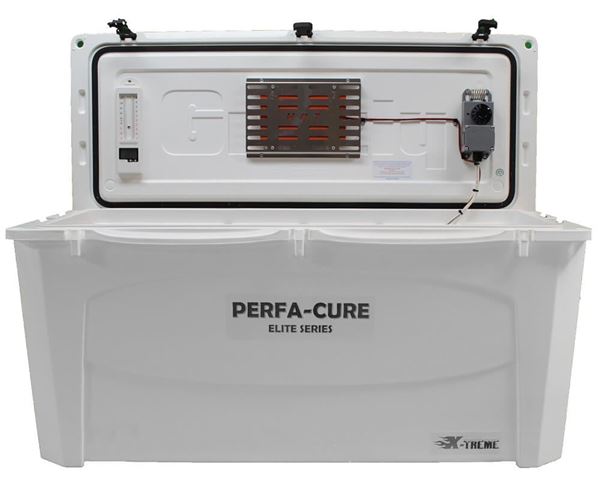
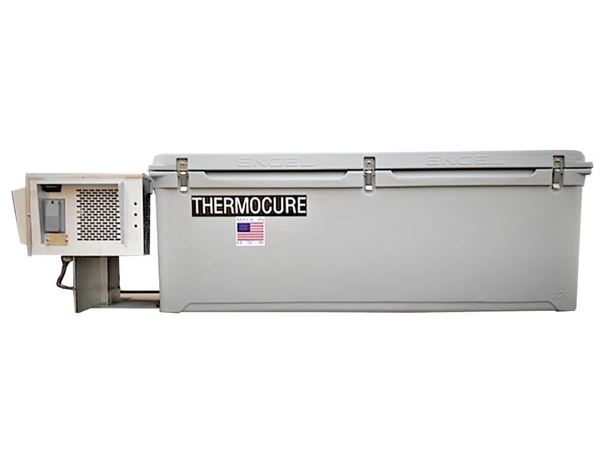
Gilson Perfa-Cure and Thermocure Curing Boxes maintain specified temperatures and moisture conditions for the initial curing of test cylinders. The rugged, portable boxes meet ASTM C31 and AASHTO T 23 specifications, and models with full cooling functionality are available for hot-weather conditions.
Section 7.1 of the guide also emphasizes the need for more frequent slump, air content, temperature, and unit weight tests on plastic concrete to monitor the immediate effects of hot weather conditions. Technicians should be alert for situations that require molding additional sets of strength samples. Documented strength development is compromised if tempering water is added after primary sampling of the load, or if the load exceeds the specified time or temperature limits, and additional sets of cylinders or beams will track potential deficiencies.
Section 7.2 covers the inspection and documentation required before and during concrete placement. Hot-weather conditions may call for measures like cooling of forms and subgrade with water, or the use of special admixtures or ice in the concrete mixture.
When operating under hot weather specifications, ambient and concrete temperatures, wind speed, relative humidity, cloud cover, and evaporative rate must be recorded every hour. Monitoring current conditions provides valuable input when considering adjustments to protective or preventative measures. Reviewing this data can also clarify issues if later troubleshooting is required.
Measuring the Effects of Hot Weather
Observed ambient values can be used on the spot to calculate the evaporative loss of surface moisture from the concrete. As noted in this earlier Gilson blog article, temperatures, humidity, and wind are direct causes for the high evaporative rate that sets up plastic shrinkage cracking in early-age concrete, particularly in slabs and pavement.
In 1954, Carl Menzel of the Portland Cement Association (PCA) developed an equation to determine the evaporative rate:
W = 0.44(eo - ea)(0.253 + 0.096V)
Where:
- W = weight (lb) of water evaporated per square foot of surface per hour (lb/ft²/hr),
- eo = pressure of saturated vapor pressure at the temperature of the evaporating surface, psi,
- ea = vapor pressure of air, psi, and
- V = average horizontal air or wind speed in mph, measured at about 20in above the evaporating surface
By 1960, the complex equation had been greatly simplified with a nomograph by Delmar Bloem, an engineer with the National Ready-Mixed Concrete Association (NRMCA) and National Sand and Gravel Association (NSGA). This popular graphic is included in 305R-20 and is still in wide use today:
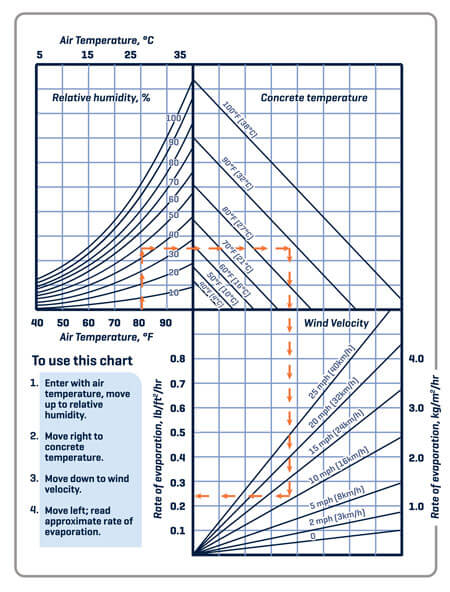
Nomograph to Estimate Evaporative Rate
Monitoring and Recording Weather Conditions
From monitoring ambient values hour by hour to automating evaporative rate measurements, you can rely on Gilson to provide the most reliable instrumentation.
- Kestrel Environmental Meters are powerful, handheld units programmed specifically to monitor, calculate, and log all the relevant values noted in ACI 305R and 308R guides for hot-weather concreting and external concrete curing.
- Air Temperature
- Wind speed
- Relative humidity
- Barometric Pressure
- Evaporative rate
- Dew Point
- Heat Stress
- Wind chill
- A sling psychrometer is an old-school, analog device, but still an accurate and reliable method for measuring relative humidity in field conditions.
- Temperature and Relative Humidity Data Loggers are a good choice for automated logging of ambient temperature and relative humidity values.
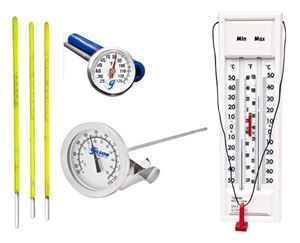
- A large selection of liquid-in-glass, digital, and bimetallic thermometers is available for monitoring concrete or ambient temperatures.
We hope this article helps you understand the effects of hot weather on concrete placements and provides strategies for adjusting to these conditions. Please contact the testing experts at Gilson to discuss your applications.
Gilson Is Here to Help
Contact our testing experts for more information or to discuss your testing application.
Testing Resources
Standard Test Methods, Specifications, and Practices
Individual test methods and specifications referenced in our product descriptions, blog articles, and videos are available for review or purchase from the professional organizations noted.
- ASTM International (American Society for Testing and Materials)
- AASHTO (American Association of State Highway and Transportation Officials)
- ACI (American Concrete Institute)
- State DOTs (Departments of Transportation)
- ISO (International Organization for Standardization)
- BS (British Standards)
- EN (European Standards)